CATCHFIRE: the reversible, self-reporting protein dimerizer
The Science Behind CATCHFIRECATCHFIRE: a self-reporting, reversible protein dimerizer
CATCHFIRE, Chemically Assisted Tethering of CHimera by Fluorogenic-Induced Recognition, is a fluorogenic chemically induced dimerization (CID) technology. In a single step, one small molecule brings two chosen proteins together and makes their new assembly fluorescent, so you can trigger a protein interaction and watch it happen at the same moment. Introduced in Nature Methods in 2023 by Prof. Arnaud Gautier and Dr. Franck Perez, co-founders of The Twinkle Factory, CATCHFIRE is the first self-reporting, reversible protein dimerizer: it turns the control of protein proximity into a directly observable, switchable event.

The CATCHFIRE principle: a fluorogenic match glue recruits FIREmate- and FIREtag-fused proteins into a reversible, fluorescent ternary assembly (left), using dyes that span green to far-red (right).
How CATCHFIRE works
Two proteins of interest are genetically fused to two small partner domains, FIREmate and FIREtag (the latter just 10 amino acids). A cognate fluorogenic “molecular glue” of the match family then bridges the two domains, and the ternary assembly lights up, the signal of match550, for instance, rises about 100-fold on binding. Because the glue is added rather than genetically encoded, the interaction is fully reversible: wash the match out and the two proteins part again.
- Self-reporting, the glue is the fluorophore, so recruitment is read out directly, with no separate reporter to build.
- Multicolour, match540 (green), match600 (orange) and match715 (far-red) glues span the spectrum for multiplexed experiments.
- Actuation-only mode, matchDark, a non-fluorescent glue, drives proximity without adding a fluorescent signal when you don’t want one.
- Tiny footprint, the 10-aa FIREtag minimises perturbation of the tagged protein.
How CATCHFIRE compares with other proximity tools
Controlling protein proximity is a cornerstone of modern cell biology, and CATCHFIRE fills a niche older tools do not:
- vs. classical chemical dimerizers (rapamycin FKBP–FRB, gibberellin, abscisic acid): these induce proximity but are not self-reporting, you must add a separate fluorescent tag to see the event, and are often slow or poorly reversible; CATCHFIRE reports and reverses on its own.
- vs. optogenetic dimerizers (CRY2–CIB1, iLID, Magnets): light control is fast, but it needs illumination hardware, can be phototoxic, and competes with the imaging channels; CATCHFIRE uses a simple, inexpensive small-molecule glue instead.
- vs. split fluorescent reporters (splitFAST, split-GFP): those report an interaction but cannot induce one, CATCHFIRE does both.
What you can do with CATCHFIRE
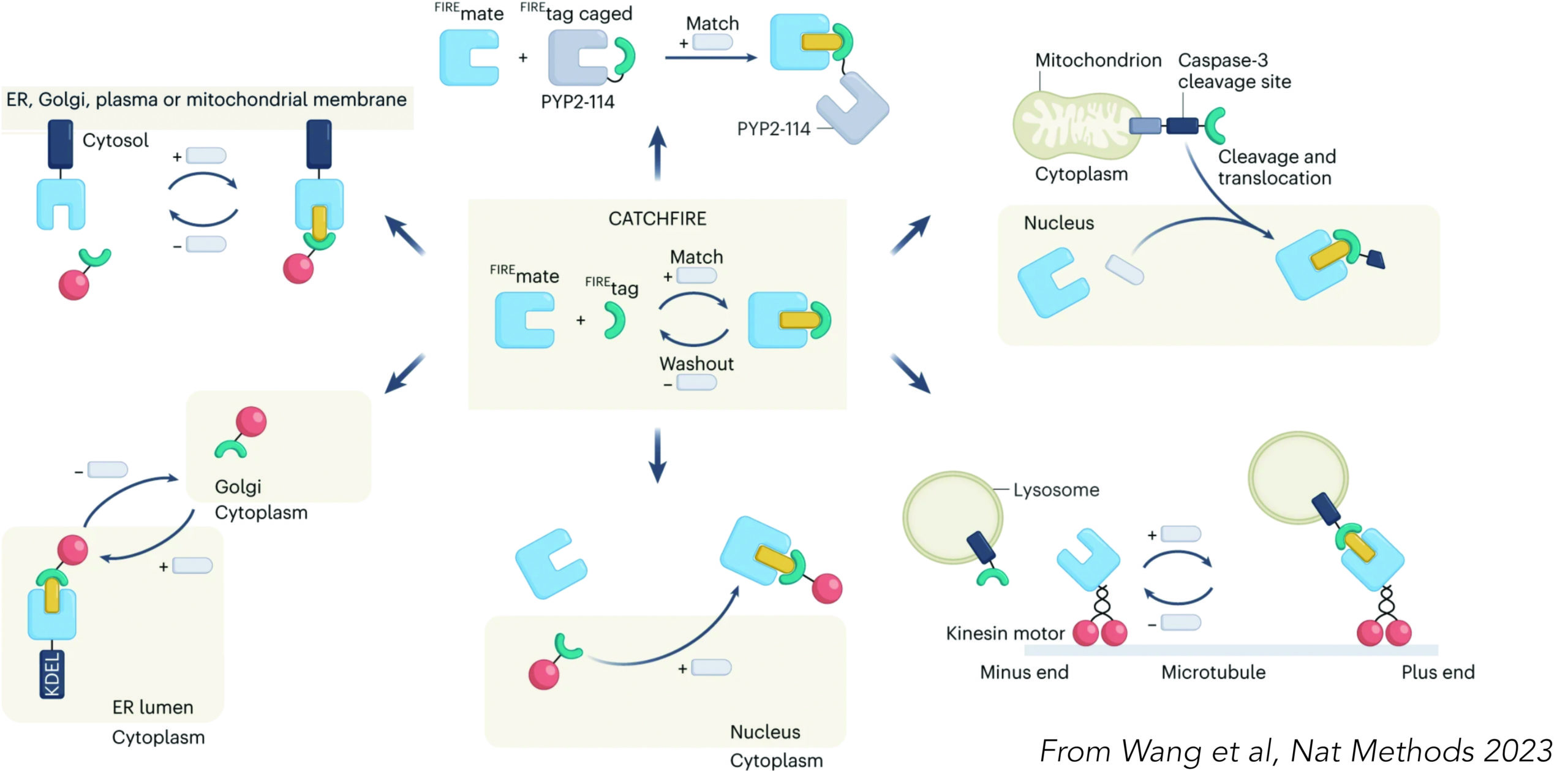
A sampling of CATCHFIRE applications, membrane and organelle recruitment, transport, translocation and biosensing (from Wang et al., Nat. Methods 2023).
Because a single reagent both actuates and reports proximity, CATCHFIRE has quickly found a broad range of uses:
- Targeted recruitment, deliver a protein to the ER, Golgi, plasma or mitochondrial membrane on demand.
- Organelle positioning and transport, couple organelles such as lysosomes to motor proteins and move them along microtubules.
- Inducible translocation, drive a protein into the nucleus, then release it by washout.
- Biosensing, report enzymatic events such as caspase-3 activity during apoptosis.
- Light control, a caged FIREtag adds photo-activation for spatial precision.
- Drug discovery, high-throughput screening of protein–protein interactions and cellular pathways.
A fast-growing toolbox
Since its 2023 debut, CATCHFIRE has moved quickly from a method to a platform. It shares its fluorogen chemistry with the FAST family, the match glues are HBR-derived, like the TFFluorogens, which is why the two technologies interoperate so naturally. The surrounding literature is already expanding from foundational cell-biology applications toward high-throughput screening in bacteria, organelle-contact-site studies, and near-infrared variants, marking CATCHFIRE as one of the most versatile entries in the chemogenetics toolbox.
Get started with CATCHFIRE using our match molecular glues and kits.
Explore the peer-reviewed evidence
CATCHFIRE and its applications are documented in a growing body of peer-reviewed work. Browse the searchable database below, filter by year or publication type, with a direct link to every paper.
Unexpected functional role of the transactivation domain for nuclear import of STAT5
Used CATCHFIRE to reveal an unexpected role of the STAT5 transactivation domain in nuclear import.
Chemically Responsive Protein Switches for the Precise Control of Biological Activities
Used CATCHFIRE chemically-induced dimerization to build reversible protein switches: assembling split enzymes (luciferases, proteases, DNA recombinases) and a titratable inducible gene-expression system (CATCH-ON, via GAL4/p65Δ) to control activities including insulin secretion and suicide switches.
Chemogenetic timestamping for the precise tracing of cell history into protein assemblies
A preprint on chemogenetic 'timestamping' to trace cell history into protein assemblies.
Unequal mitochondrial segregation promotes asymmetric fates during neurogenesis
Used live imaging with Twinkle-team tools to show unequal mitochondrial segregation biases neuron-versus-progenitor fate in neurogenesis.
CATCHFIRE-Based Versatile and High-Throughput Screening for Protein Secretion in Bacillus subtilis
Used CATCHFIRE to build a high-throughput screen for protein secretion in Bacillus subtilis.
A tunable and versatile chemogenetic near-infrared fluorescent reporter
Introduced nirFAST, a bright 14-kDa near-infrared reporter for deep, multiplexed imaging that also doubles as a CATCHFIRE proximity tool.
Transforming chemigenetic bimolecular fluorescence complementation systems into chemical dimerizers
A preprint turning chemigenetic bimolecular fluorescence complementation systems into chemical dimerizers.
A fluorogenic chemically induced dimerization technology for controlling, imaging and sensing protein proximity
Introduced CATCHFIRE, a small-molecule 'match' that both induces protein proximity and lights it up, for controlling, imaging and sensing protein assembly, transport and interactions.
No publications match your filters.