
FAST, pFAST & splitFAST: fluorogen-activating protein tags
The Science Behind FAST, pFAST and splitFAST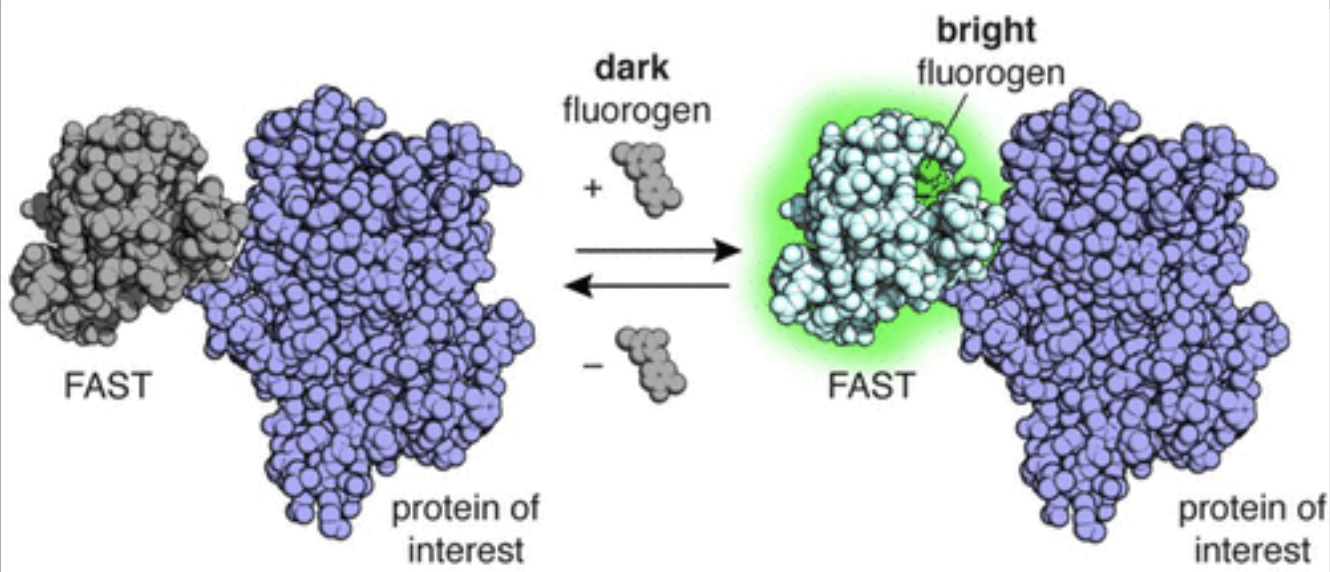
FAST: a family of fluorogen-activating protein tags for live-cell imaging
FAST, the Fluorescence-Activating and absorption-Shifting Tag, is a family of small genetically encoded protein tags that become fluorescent only while they hold a small fluorogenic ligand, a TFFluorogen. The family descends from Y-FAST (also called FAST1), a tag of 125 amino acids (14 kDa) engineered by directed evolution (yeast display and cell sorting) from the photoactive yellow protein of the bacterium Halorhodospira halophila by the groups of Arnaud Gautier and Ludovic Jullien in Paris, and first reported in PNAS in 2016. Half the size of GFP and fully monomeric, it has since branched into iFAST, splitFAST, pFAST, RSpFAST and many more: the FAST family of chemogenetic reporters.
The principle is simple. A TFFluorogen is dark in solution. When it binds FAST, the protein locks it in a planar, emissive state: its fluorescence rises by about 200 to 660-fold, depending on the fluorogen, and its absorption shifts by 80 to 110 nm to the red. Fuse FAST to a protein of interest, add the TFFluorogen to the medium, and that protein lights up with high contrast and no washing step, because unbound fluorogen stays invisible.
How FAST behaves in the cell
- Instant and reversible. Binding is non-covalent: a TFFluorogen stays bound for about 160 ms (measured for TFLime) before exchanging. Cultured cells are labelled within about ten seconds, washing the fluorogen out switches the signal off on a similar timescale, and ten on/off cycles have been run in the same living cells.
- Fluorescent as soon as it folds. There is no chromophore to mature. In cell-free expression FAST is detected after 10 min, when mCherry only starts to appear after 50 min.
- Oxygen-independent. GFP-type proteins need molecular oxygen to build their chromophore; FAST needs none, so it reports in anaerobes, biofilms and tumour-colonising bacteria.
- Self-renewing signal. Photodamaged fluorogen is continuously replaced from the medium, which slows apparent photobleaching; with TFCoral, pFAST is as photostable as mCherry.
- Gentle on cells and embryos. Zebrafish embryos kept for 19 hours with TFLime showed no mortality and no developmental defects.
- Small and monomeric. At 14 kDa and monomeric up to millimolar concentrations, FAST minimises perturbation of the protein it tags.
One tag, many colours: the TFFluorogen palette
Because the colour is carried by the ligand, the same FAST construct can be imaged in different colours simply by choosing a different TFFluorogen. Each variant of the family has its preferred partners:
| TFFluorogen | Chemical name | Ex / Em (nm) | Pairs with |
|---|---|---|---|
| TFLime | HMBR | 480 / 541, green | FAST, splitFAST, greenFAST, pFAST |
| TFAmber | HBR-3,5DM | 499 / 558, yellow | FAST, splitFAST, pFAST |
| TFCoral | HBR-3,5DOM | 516 / 600, orange-red | FAST, splitFAST, redFAST, pFAST, nirFAST |
| TFPoppy | HPAR-3OM | 555 / 670, far-red | frFAST, nirFAST |
| TFCarmine | HPAR-3,5DOM | 636 / 715, near-infrared | nirFAST |
| TFAmber-NP | HBRAA-3E | 505 / 559, yellow, non-permeant | FAST, pFAST (cell surface) |
| TFFox-NP | HBRAA-3,5DM | 524 / 578, orange, non-permeant | pFAST (cell surface) |
| TFDarth | HBIR-3M | dark quencher (absorbs at 514 nm) | pFAST (FRET, FLIM-FRET) |
Cell-permeant TFFluorogens label intracellular proteins; the membrane-impermeant NP fluorogens stay outside the cell and label only proteins exposed at the surface, ideal for trafficking studies and flow cytometry.
Ex / Em values are given with iFAST for TFLime, TFAmber and TFCoral, frFAST for TFPoppy, nirFAST for TFCarmine, FAST for TFAmber-NP and pFAST for TFFox-NP. They shift by a few nanometres from one variant to another; redFAST, for instance, moves the excitation of TFCoral to 556 nm.
Why choose FAST?
- No-wash, high-contrast imaging: only the bound TFFluorogen fluoresces.
- Reversible labelling: switch the signal on and off at will, for dynamic and repeated experiments.
- Works without oxygen: the reporter of choice for anaerobic bacteria, archaea, biofilms and tumour-colonising bacteria.
- One tag, many colours: pFAST alone spans blue to red by changing the ligand, without re-cloning, and nirFAST extends the range to near-infrared.
- Small footprint: 14 kDa, half the size of GFP; the smallest splitFAST fragment is only 10 to 11 amino acids.
- Brightness when you need it: tandem versions such as td-iFAST are 1.6-fold brighter than EGFP and 2-fold brighter than mCherry.
How FAST compares with other labelling technologies
FAST belongs to the family of chemogenetic reporters, alongside self-labelling enzymes. Each technology has its strengths:
- vs. fluorescent proteins (GFP, mCherry): FAST is about half the size of GFP (14 vs 27 kDa), is fluorescent immediately, and works without oxygen. In growing E. coli biofilms, GFP fluorescence saturated after about 5 hours as oxygen ran short, while FAST kept tracking biofilm growth for 20 hours.
- vs. self-labelling tags (HaloTag, SNAP-tag, CLIP-tag): HaloTag (33 kDa) and SNAP-tag (19.4 kDa) bind their dyes covalently and permanently, and SNAP-tag substrates usually need a wash. FAST labels non-covalently and instantly, with no wash, and can be switched off. Covalent tags keep the edge where a permanent label matters: pulse-chase experiments and the very highest photostability with bright rhodamine dyes for single-molecule work.
- In anaerobes, side by side: in Clostridium acetobutylicum and C. ljungdahlii, FAST, HaloTag and SNAP-tag all work and are mutually orthogonal; FAST was the fastest to label and the smallest of the three.
Choosing a protein-labelling tag? See our detailed, point-by-point guide: FAST vs GFP, HaloTag & SNAP-tag →
A growing FAST family, a short history
Each new variant since 2016 has opened a new imaging modality:
2016, Y-FAST, the original tag
The founding paper introduced Y-FAST (also referred to as FAST1), the first member of the family: a 14 kDa tag with reversible, oxygen-independent fluorogen chemistry and TFLime (HMBR) as its first partner (PNAS 2016).
2017 to 2018, a palette of colours and a brighter tag
New TFFluorogens tuned the emission from green to orange-red, with TFAmber and TFCoral (Chem. Sci. 2017). A single mutation (V107I) gave iFAST (also known as FAST2), brighter and higher-affinity, and its tandem td-iFAST outshone EGFP and mCherry (Biochemistry 2018). Membrane-impermeant fluorogens such as TFAmber-NP made cell-surface-selective labelling possible (Bioconjugate Chem. 2018).
2019, splitFAST for protein–protein interactions
Split into a large fragment and a short peptide of 10 to 11 amino acids, splitFAST becomes fluorescent only when the two partners it is fused to come together (Nature Communications 2019). Complementation is rapid and fully reversible: unlike BiFC, which is irreversible and slow to mature, splitFAST follows both the formation and the dissociation of a complex in real time.
2020, frFAST for far-red imaging
Paired with TFPoppy (HPAR-3OM, 555/670 nm), frFAST pushed the palette into the far-red for deeper imaging with less autofluorescence, demonstrated in mammalian cells, zebrafish and chicken embryos (Angew. Chem. 2020).
2021, greenFAST and redFAST, orthogonal two-colour imaging
greenFAST and redFAST each select their own fluorogen, TFLime and TFCoral respectively, so two proteins can be imaged side by side without crosstalk: 99% of greenFAST carries TFLime and 95% of redFAST carries TFCoral in the same cell. A two-colour cell-cycle sensor built with them resolved cycles as short as 15 minutes in zebrafish embryos (Nature Chemical Biology 2021).
2021, pFAST, one tag across the whole palette
pFAST, the “promiscuous” FAST, binds a whole palette of fluorogens more tightly than FAST does, so a single tag can be imaged in tunable colours across the visible spectrum, with emission from 473 to 616 nm depending on the fluorogen (Nature Communications 2021). pFAST works in 3D STED nanoscopy, still labels after fixation, and, paired with a dark fluorogen, serves as an acceptor for FLIM-FRET biosensors.
That palette is exactly why we extended the TFFluorogen range, so a pFAST experiment can be equipped end-to-end from one source:
- TFLime (HMBR), green
- TFAmber (HBR-3,5DM), yellow
- TFCoral (HBR-3,5DOM), orange-red
- TFFox-NP (HBRAA-3,5DM), a non-permeant fluorogen for selective labelling of cell-surface pFAST proteins
- TFDarth (HBIR-3M), a dark quencher for FRET and FLIM-FRET
pFAST has since become a platform in its own right: tandem td-pFAST for reversible multicolour labelling in dissected C. elegans tissues (microPublication Biology 2026), LumiFAST, which tunes the colour of NanoLuc bioluminescence (ACS Sensors 2026), and RSpFAST, a reversibly photoswitchable label for dynamic-contrast and super-resolution imaging (JACS 2026). Split into two parts, pFAST also gave rise to CATCHFIRE, our fluorogenic chemically induced dimerization system (Nature Methods 2023).
2021, nanoFAST, the smallest tag
Removing 26 N-terminal residues gave nanoFAST, only 98 amino acids long, the shortest genetically encoded fluorogen-activating tag reported at the time (Chem. Sci. 2021).
2024, brighter splits, lifetimes and contact sites
splitFAST2, built on RspA, a photoactive yellow protein ortholog carrying the FAST mutations, combines higher brightness with lower background complementation (ACS Chem. Biol. 2024). FAST variants with distinct fluorescence lifetimes allow FLIM multiplexing: three targets per colour channel, six when combined with colour, in live cells and zebrafish larvae (Adv. Sci. 2024). splitFAST probes now map and even measure calcium at organelle contact sites between the ER and mitochondria (Nature Communications 2024).
2025, near-infrared, three-part splits and heat-stable tags
nirFAST binds TFCarmine (HPAR-3,5DOM) with nanomolar affinity (36 nM) and emits at 715 nm, brighter in cells than the near-infrared fluorescent proteins emiRFP670 and miRFP713 and compatible with STED (Nature Communications 2025). A tripartite split-pFAST reveals ternary protein complexes (Nature Communications 2025), and the FAST-based HyPerFLEX sensor measures hydrogen peroxide from green to far-red, even under hypoxia (Nature Chemical Biology 2025). Directed evolution in a heat-loving bacterium produced heat-stable FAST variants that stay fluorescent above 55 °C (ACS Synth. Biol. 2025), and splitFAST2 combined with STED mapped protein-protein interactions below the diffraction limit in living cells (ChemBioChem 2025).
2026, light-controlled colours, gated FRET and disease biology
RSpFAST turns pFAST into a reversibly photoswitchable label (JACS 2026). Supplied with two fluorogens at once, pFAST also becomes a reversibly photoconvertible tag: under light it swaps its green fluorogen for a red one, then switches back in the dark, a colour change that also tells apart FAST variants with near-identical spectra (Adv. Sci. 2026).
Crystal structures of FAST with and without its fluorogen show how binding reshapes the pocket, and FAST used as a FRET acceptor that the fluorogen switches on and off gives reversible, ligand-gated FLIM-FRET (Adv. Sci. 2026). A sulfur-substituted fluorogen (HBTR-3,5-DOM) extends pFAST into the far-red for lifetime-multiplexed imaging (Int. J. Mol. Sci. 2026), and an independent evaluation showed that frFAST supports single-molecule localisation, fluctuation-based super-resolution and live-cell STED without harsh imaging buffers (Methods Appl. Fluoresc. 2026).
FAST is now a tool for disease biology too: splitFAST2 probes counted ER-mitochondria contacts and timed how long they last in live liver cells, linking persistent contacts to metabolic liver disease (J. Clin. Invest. 2026). The family keeps growing, and so does our TFFluorogen range.
Where FAST is used
FAST reporters have been used in some thirty organisms, from gut anaerobes and archaea to zebrafish, plants and nematodes:
- Anaerobic microbiology: gene expression and protein localisation in Clostridium species (including sporulation genes in C. difficile and C. perfringens, and newer hosts such as C. kluyveri and C. cellulovorans), acetogens such as Eubacterium limosum, Eubacterium callanderi and Acetobacterium woodii, where green and red variants allow two-colour work and reporters stay bright under carbon monoxide, methanogenic archaea including Methanococcus maripaludis and Methanothermobacter thermautotrophicus, and the anaerobic parasite Giardia. GFP and mCherry fail in all of these without oxygen. The more thermostable pFAST gave the first fluorescent reporter for an anaerobic thermophile, Thermoanaerobacter kivui, which grows at 60 to 70 °C.
- Biofilms, infection and the microbiome: faithful reporting across the oxygen gradients of biofilms, imaging of Pseudomonas aeruginosa biofilms under anaerobic conditions, secretion of bacterial effectors by Shigella and Listeria, intracellular antibiotic levels in Vibrio cholerae, engineered skin and gut commensals, bacteria lit up inside the mouse gut (imaged after dissection) and two-colour imaging of engineered bacteria in tumours.
- Whole organisms: zebrafish embryos and larvae, chicken embryos, C. elegans tissues, plants (Arabidopsis, Nicotiana benthamiana), the yeasts Saccharomyces cerevisiae and Candida albicans, and viruses such as HIV-1 and influenza A in infected human cells.
- Cell biology: protein-protein interactions, organelle and lipid-droplet contact sites (including ER-mitochondria contacts in liver cells), and protein trafficking between the cell surface and the interior.
- Techniques: confocal microscopy, STED and other super-resolution methods including single-molecule localisation, FLIM and lifetime multiplexing, two-photon imaging of FAST-based sensors, and flow cytometry, including of anaerobes and methanogenic archaea.
Explore dedicated pages on labelling in anaerobes and on detecting protein–protein interactions, or the full applications overview.
Good to know
- The TFFluorogen must stay in the medium during imaging, typically at 5 to 20 µM; removing it switches the signal off. That reversibility is a feature for dynamic studies, but FAST is not a permanent label.
- For single-molecule work that needs the ultimate brightness and photostability, covalent tags with rhodamine dyes remain the reference.
- In thick samples, allow the fluorogen time to penetrate: seconds for cultured cells, tens of minutes for zebrafish embryos or plant leaves.
Explore the full range of FAST TFFluorogens in our catalogue, or discover CATCHFIRE, our fluorogenic molecular-glue system for inducible, self-reporting protein proximity.
Explore the peer-reviewed evidence
FAST, pFAST, splitFAST and their variants now feature in close to a hundred studies, from multicolour and far-red imaging to anaerobic and in vivo work. Search the database below, filter by reporter, year or type, and open any paper directly.
Non-Covalent Reversibly Photoconvertible Fluorescent Tags for Wash-Free Protein Labeling
Showed that FAST-family tags turn into negative reversible photoswitchers when fluorogen concentration is lowered and light intensity raised, and that pairing two fluorogens yields positive photoswitchers and non-covalent reversibly photoconvertible tags that change color under light. Exploiting this light-driven color change in two spectral channels, the authors distinguish up to six spectrally similar FAST variants in live cells.
Reversible, Chemically Gated FRET via Ligand-Activated Acceptors
First crystal structures of apo and ligand-bound FAST, showing that N-terminal residues occlude the empty pocket and are displaced on fluorogen binding to form a water-stabilized cavity. Different hydroxybenzylidene rhodanine fluorogens tune the binding geometry and yield single or multiexponential fluorescence lifetimes, which the authors exploit to use FAST as a chemically gated, reversible FRET acceptor for ligand-controlled FLIM-FRET, mapping MAGUK scaffold organization in live cells.
Evaluating the far-red emitting fluorescence-activating and absorption-shifting tag (frFAST) chemogenetic labeling system for live-cell super-resolution microscopy
Reported far-red chemogenetic FAST labeling approaches for background-free super-resolution imaging of intracellular targets.
Excessive EFHD1-dependent ER-mitochondrial contacts drive a maladaptive antiviral response in metabolic liver disease
Used splitFAST revealed by TF-Lime to count ER-mitochondria contacts and time their lifetime live in HepG2 cells, showing that the Ca2+-dependent actin cross-linker EFHD1 stabilizes these contacts. In metabolic liver disease (MASH), EFHD1 excess makes contacts persist, fragments mitochondria and triggers a maladaptive antiviral stress response; inhibiting EFHD1 protects hepatocytes.
Kinetic and Mechanistic Characterization of RSpFAST, a Non-Covalent Versatile Chemogenetic Platform for Fluorescence Imaging
Introduces RSpFAST (a pFAST tag paired with a reversibly photoisomerizable fluorogen) and characterizes its thermokinetics, photochemistry and structure. Reveals a dual regime: a stable wash-free label becomes a negative photoswitcher at low fluorogen concentration and high light (photoejection-driven), enabling dynamic-contrast and super-resolution imaging in live and fixed cells.
HIV-1 Nef Homodimerization as a Structural Mechanism for Kinase Activation and Small Molecule Inhibitor Action
Showed that mutating the HIV-1 Nef dimer interface residues Leu112 and Phe121 abolishes dimerization while preserving the Nef fold, giving monomeric complexes with Hck kinase domains. Used a splitFAST complementation assay to provide direct evidence that small-molecule inhibitors disrupt Nef homodimer formation in solution.
A characterized promoter suite enables metabolic rewiring of the acetogen Acetobacterium woodii toward ethanol production
Developed a modular plasmid platform and a suite of characterized native, heterologous and methanol-inducible promoters for the acetogen Acetobacterium woodii, using pFAST with HMBR as the anaerobe-compatible reporter to quantify promoter strength. Replacing the native adhE promoter and deleting the neighbouring LysR-type regulator shifted the strain from acetogenic toward partly ethanologenic, yielding ethanol from fructose and from the C1 substrates methanol plus CO2 and formate plus syngas.
Chemogenetic timestamping for the precise tracing of cell history into protein assemblies
A preprint on chemogenetic 'timestamping' to trace cell history into protein assemblies.
The fluorescence‐activating and absorption‐shifting tag (FAST), a versatile protein marker for live plant cell imaging
Established FAST, greenFAST/redFAST and splitFAST for versatile multicolor imaging in plant cells.
Establishing the fluorescence-activating and absorption-shifting tag as a fluorescent reporter
A preprint establishing FAST as a fluorescent reporter in a new host system.
Chemogenetic Modulation of Luciferase Emission Color for Imaging and Sensing
Introduced LumiFAST, a chemogenetic way to tune luciferase emission color, for bioluminescence imaging and sensing.
Enabling Plasmid-Based Expression in Clostridium kluyveri Using a Biparental Methylation-Conjugation System
Built a biparental methylation-conjugation system that bypasses restriction-modification barriers in Clostridium kluyveri DSM 555T, enabling stable plasmid delivery, and used FAST with HMBR as an oxygen-independent reporter to confirm heterologous expression (peak emission 542 nm, measured by plate reader). Opens C. kluyveri, a chain-elongating biocatalyst for medium-chain fatty acids, to metabolic engineering.
Monitoring intracellular antibiotic concentrations in real-time using allosteric biosensors
Used a FAST-based allosteric biosensor to monitor intracellular antibiotic concentrations in real time.
Development of carbon monoxide-tolerant fluorescent reporter system functional under anoxic conditions in Eubacterium callanderi KIST612
Built a fluorescent reporter system for the acetogen Eubacterium callanderi KIST612 that works under strict anoxia and tolerates carbon monoxide, after characterizing the strain autofluorescence and selecting FAST with HMBR as the best-suited reporter. FAST-expressing strains were about 4.5 times brighter than controls in both glucose and CO conditions, and a CO-sensing construct gave fluorescence proportional to CO partial pressure.
Random Mutagenesis-Based Optimization of the Fluorogen-Activating Protein picoFAST
Optimized picoFAST, an ultra-small fluorogen-activating protein, by random mutagenesis.
Inactive ryanodine receptors sustain lysosomal availability for autophagy by promoting ER-lysosomal contact site formation
Used splitFAST to study how inactive ryanodine receptors sustain lysosomal autophagy in Alzheimer's models.
Reversible Chemogenetic Fluorescence Labeling with pFAST in C. elegans
Made a tandem pFAST (td-pFAST) C. elegans strain for reversible multicolor chemogenetic labeling in worms.
Bathochromic Shift via C=O to C=S Substitution: A Far-Red Fluorogen for Multiplexed FLIM with FAST Fluorogen-Activating Protein
Extended the FAST palette into the far-red with HBTR-3,5-DOM, a fluorogen made by C=O-to-C=S substitution.
Imaging and quantifying organelle contact sites using a reversible splitFAST complementation assay
A methods chapter on imaging and quantifying organelle contact sites with a reversible splitFAST complementation assay.
Anaerobic Fluorescent Reporters for Studying Pseudomonas aeruginosa-Specific Responses in a CF Polymicrobial Assay
A PhD thesis developing anaerobic FAST reporters to study Pseudomonas aeruginosa responses.
Early HIV-1 maturation drives Env clustering and fusion competence
Studied how early HIV-1 maturation drives Env clustering and fusion competence, using FAST-family imaging.
Super-Resolution Live-Cell Mapping of Protein-Protein Interactions Using Chemogenetic splitFAST
Mapped protein-protein interactions at super-resolution in live cells using chemogenetic splitFAST.
A color-tailored fluorogenic sensor for hydrogen peroxide
Built HyPerFLEX, a FAST-based color-tunable fluorogenic sensor for high-precision H2O2 detection in living cells.
Thermophilic Chassis-Enabled High-Throughput Selection of a Thermostable Fluorogenic Reporter
Selected thermostable FAST variants (hsFAST/tsFAST) via a thermophilic-chassis high-throughput screen.
Human MX1 orchestrates the cytoplasmic sequestration of neo-synthesized influenza A virus vRNPs
Applied splitFAST to dissect how human MX1 sequesters newly made influenza vRNPs in the cytoplasm.
Fluorescence Lifetime-Based Separation of FAST-Labeled Cellular Compartment
A step-by-step protocol for FAST-based fluorescence-lifetime imaging (FLIM) to separate labels sharing a color channel.
Synthetic protein degradation circuits using programmable cleavage and ligation by Sortase A
Used splitFAST as the readout of a peptide bond being made or broken: Sortase A ligates the two fragments to switch fluorescence on, and cleaves a full-length FAST carrying an LPETGGG motif to switch it off, driving logic-gated protein degradation in live HeLa cells.
Type IV Pili-Associated Secretion of a Biofilm Matrix Protein From Clostridium perfringens That Forms Intermolecular Isopeptide Bonds
Characterized type IV pili-associated secretion of a biofilm matrix protein in Clostridium perfringens, using FAST.
Characterization of Fluorescent Reporters for Flow Cytometry-Based Single-Cell Studies in Saccharomyces cerevisiae
Benchmarked green/red/blue fluorescent reporters, including frFAST, for flow-cytometry single-cell studies in yeast.
Design and evaluation of a tripartite chemogenetic fluorescent reporter for visualizing ternary protein complexes
Engineered a tripartite (three-fragment) splitFAST that lights up only when three proteins assemble, visualizing ternary complexes in live cells.
Lipid droplet dysmetabolism affects cell homeostasis in an in vitro model of Alzheimer’s disease
Applied splitFAST to link lipid-droplet dysmetabolism to cell-homeostasis defects in an in-vitro Alzheimer's model.
Cell-surface receptor-mediated regulation of synaptic organelle distribution controls dendritic spine maturation
Used chemogenetic FAST reporters to study how cell-surface receptors position the spine apparatus for dendritic-spine maturation.
Hi-TARGET: A fast, efficient and versatile CRISPR type I-B genome editing tool for the thermophilic acetogen Thermoanaerobacter kivui
Built a CRISPR type I-B genome-editing toolkit for the thermophilic acetogen Thermoanaerobacter kivui, with pFAST as a fluorescent reporter.
A tunable and versatile chemogenetic near-infrared fluorescent reporter
Introduced nirFAST, a bright 14-kDa near-infrared reporter for deep, multiplexed imaging that also doubles as a CATCHFIRE proximity tool.
Nano-frFAST: Design of a New Genetically-Encoded Far-Red Fluorescent Label
Designed nano-frFAST, a small far-red fluorogen-activating protein, with a matching series of extended-pi fluorogens.
Synthetically programmed antioxidant delivery by a domesticated skin commensal
Engineered a skin commensal bacterium for programmed antioxidant delivery, using FAST to fluorescently track the strains.
A rapid genome-proteome approach to identify rate-limiting steps in the butyrate production pathway in probiotic <i>Clostridium butyricum</i>, CBM588
A genome-proteome approach to find rate-limiting steps in butyrate production by Clostridium butyricum, with FAST reporting.
Deletion of atypical type II restriction genes in Clostridium cellulovorans using a Cas9-based gene editing system
Improved genetic accessibility of the biofuel-relevant anaerobe Clostridium cellulovorans, using FAST as an anaerobic reporter.
Mitophagy and release of mitochondrial derived vesicles in cellular models of inducible unfolded protein accumulation in mitochondrial matrix and intermembrane space.
Studied mitophagy and mitochondrial-derived vesicles in inducible cell models, using FAST-family reporters.
Multipartite Fluorogenic Sensors for Monitoring Tyrosine Phosphatase Activity
First steps toward genetically encoded FAST-based sensors for protein tyrosine phosphatase activity.
Simultaneous detection of membrane contact dynamics and associated Ca2+ signals by reversible chemogenetic reporters
Built reversible splitFAST reporters that simultaneously visualize membrane contact-site dynamics and the Ca2+ signals they carry.
The genetic architecture of protein interaction affinity and specificity
Used splitFAST to quantify how every mutation in the transcription factor JUN reshapes binding across a protein family, mapping interaction affinity and specificity.
A versatile bioluminescent probe with tunable color
A tunable-color bioluminescent probe, from FAST-family chemogenetic reporter engineering.
Design of fully synthetic signal peptide library and its use for enhanced secretory production of recombinant proteins in Corynebacterium glutamicum
Built a synthetic signal-peptide library to boost protein secretion in Corynebacterium glutamicum, using FAST-based secretion reporting.
Lactate-mediated mixotrophic co-cultivation of Clostridium drakei and recombinant Acetobacterium woodii for autotrophic production of volatile fatty acids
Engineered a Clostridium/Acetobacterium co-culture for autotrophic fatty-acid production, with FAST as a fluorescent strain marker.
FAM122A ensures cell cycle interphase progression and checkpoint control by inhibiting B55α/PP2A through helical motifs
Used splitFAST complementation to characterize how FAM122A binds and inhibits the B55-alpha/PP2A phosphatase to control the cell cycle.
Fluorescence lifetime multiplexing with fluorogen activating protein FAST variants
Baranov-group FAST FLIM multiplexing: FAST mutants sharing a fluorogen but differing in fluorescence lifetime, telling several labels apart by lifetime.
A fluorogenic complementation tool kit for interrogating lipid droplet–organelle interaction
A fluorogenic splitFAST toolkit for detecting lipid-droplet-organelle contact sites at nanometer scale in living cells.
Expression and Subcellular Localization of Lanthipeptides in Human Cells
Expressed and localized lanthipeptides in human cells, using FAST-based fluorescent reporting.
Multiplexed In Vivo Imaging with Fluorescence Lifetime-Modulating Tags
Introduced FAST variants tuned to distinct fluorescence lifetimes, enabling highly multiplexed in-vivo imaging by lifetime rather than color.
LowTempGAL: a highly responsive low temperature-inducible GAL system in Saccharomyces cerevisiae
A low-temperature-inducible gene-expression system in yeast, read out with FAST-based fluorescence.
A multi-colour fluorogenic tag and its application in Candida albicans
Applied a multi-colour fluorogenic FAST tag in the fungal pathogen Candida albicans.
A Combination of Library Screening and Rational Mutagenesis Expands the Available Color Palette of the Smallest Fluorogen-Activating Protein Tag nanoFAST
Expanded the color palette of nanoFAST, the smallest (98-aa) fluorogen-activating protein, by mutagenesis and screening.
The multiplicity of thioredoxin systems meets the specific lifestyles of Clostridia
Studied thioredoxin redox systems across Clostridia, using FAST-based anaerobic reporting.
Improving Split Reporters of Protein–Protein Interactions through Orthology-Based Protein Engineering
Improved splitFAST's brightness and performance for detecting protein-protein interactions using orthology-based protein engineering.
Integration of Yeast Episomal/Integrative Plasmid Causes Genotypic and Phenotypic Diversity and Improved Sesquiterpene Production in Metabolically Engineered Saccharomyces cerevisiae
Explored how yeast plasmid integration drives phenotypic diversity, using FAST-based auxin-inducible protein degradation.
Refining and illuminating acetogenic Eubacterium strains for reclassification and metabolic engineering
Reclassified and metabolically engineered acetogenic Eubacterium strains, using FAST for fluorescent visualization.
Transforming chemigenetic bimolecular fluorescence complementation systems into chemical dimerizers
A preprint turning chemigenetic bimolecular fluorescence complementation systems into chemical dimerizers.
Inter-organelle contact sites: molecular modulation and generation of new probes to study their dynamics and associated signaling
A study of inter-organelle contact sites introducing new splitFAST-related probes to visualize them.
Effeсts of the 70th Amino Acid Residue on the Photostability of FAST Complexes
A FAST T70V mutant showing the 70th residue barely affects brightness or photostability.
Anaerobic fluorescent reporters for live imaging of Pseudomonas aeruginosa
Developed anaerobic FAST reporters for live imaging of Pseudomonas aeruginosa in biofilms and low-oxygen conditions.
Engineering of Tunable Allosteric-like Fluorogenic Protein Sensors
Engineered tunable allosteric-like FAST biosensors that switch fluorescence in response to a target biomolecule.
Microbiome imaging goes à la carte: Incorporating click chemistry into the fluorescence-activating and absorption-shifting tag (FAST) imaging platform
Added click chemistry to FAST imaging to label anaerobic microbiome bacteria in biofilm communities.
A fluorescent reporter system for anaerobic thermophiles
Demonstrated a FAST-based reporter that works in anaerobic thermophiles, where oxygen-dependent GFP fails.
Endogenous CRISPR/Cas systems for genome engineering in the acetogens Acetobacterium woodii and Clostridium autoethanogenum
Used endogenous CRISPR/Cas systems to engineer acetogens, with FAST for fluorescent readout.
Application of the Fluorescence-Activating and Absorption-Shifting Tag (FAST) for Flow Cytometry in Methanogenic Archaea
Applied FAST to flow-cytometry analysis and imaging of methanogenic archaea (M. maripaludis, M. acetivorans).
Fluorescence-Activating and Absorption-Shifting Nanoprobes for Anaerobic Tracking
FAST absorption-shifting nanoprobes for tracking anaerobic bacteria.
Production of propionate using metabolically engineered strains of Clostridium saccharoperbutylacetonicum
Engineered Clostridium saccharoperbutylacetonicum for propionate production, tracked with FAST.
The Fluorescence-Activating and Absorption-Shifting Tag (FAST) Enables Live-Cell Fluorescence Imaging of Methanococcus maripaludis
Showed FAST enables live-cell fluorescence imaging of the methanogenic archaeon Methanococcus maripaludis under anoxic conditions.
Encoding with a fluorescence-activating and absorption-shifting tag generates living bacterial probes for mammalian microbiota imaging
Encoded gut-microbiota bacteria with FAST to create living probes for imaging the mammalian microbiota.
Autotrophic lactate production from H2 + CO2 using recombinant and fluorescent FAST-tagged Acetobacterium woodii strains
Engineered fluorescent FAST-tagged Acetobacterium woodii for autotrophic lactate production from H2 + CO2.
Establishment of Green- and Red-Fluorescent Reporter Proteins Based on the Fluorescence-Activating and Absorption-Shifting Tag for Use in Acetogenic and Solventogenic Anaerobes
Established greenFAST and redFAST reporters for use in acetogenic and solventogenic anaerobes.
Engineering of a fluorescent chemogenetic reporter with tunable color for advanced live-cell imaging
Introduced pFAST, a promiscuous FAST that binds a whole palette of fluorogens, letting one tag be imaged in tunable colors across the visible spectrum.
Inheritance of the reduced mitochondria of Giardia intestinalis is coupled to the flagellar maturation cycle
Studied inheritance of Giardia's reduced mitochondria (mitosomes), using FAST-based imaging.
Four species of bacteria deterministically assemble to form a stable biofilm in a millifluidic channel
Used FAST to build and image a stable four-species model biofilm in a millifluidic channel.
Developing Bright Green Fluorescent Protein (GFP)-like Fluorogens for Live-Cell Imaging with Nonpolar Protein−Chromophore Interactions
Developed brighter GFP-like fluorogens for FAST using nonpolar protein-chromophore interactions.
Production of the biocommodities butanol and acetone from methanol with fluorescent FAST-tagged proteins using metabolically engineered strains of Eubacterium limosum
Produced butanol and acetone from methanol in engineered Eubacterium limosum, tracked with fluorescent FAST tags.
NanoFAST: structure-based design of a small fluorogen-activating protein with only 98 amino acids
Introduced NanoFAST, a structure-based minimal fluorogen-activating protein of just 98 amino acids.
Styrene Derivatives of Indole and Pyranone as Fluorogenic Substrates for FAST Protein
Tested styrene derivatives of indole and pyranone as new fluorogens for FAST.
Auxin-mediated protein depletion for metabolic engineering in terpene-producing yeast
An auxin-inducible protein-depletion tool for metabolic engineering in terpene-producing yeast, read out with FAST.
Color Tuning of Fluorogens for FAST Fluorogen-Activating Protein
Created a panel of color-shifted benzylidene-imidazolone fluorogens for FAST without losing binding efficiency.
Orthogonal fluorescent chemogenetic reporters for multicolor imaging
Introduced greenFAST and redFAST, spectrally orthogonal FAST variants, for simultaneous two-color imaging in live cells and zebrafish.
Interspecies Microbial Fusion and Large-Scale Exchange of Cytoplasmic Proteins and RNA in a Syntrophic Clostridium Coculture
Revealed interspecies cytoplasmic exchange in a Clostridium coculture, using FAST-based fluorescent tracking.
Fluorescent secreted bacterial effectors reveal active intravacuolar proliferation of Listeria monocytogenes in epithelial cells
Showed FAST can tag secreted bacterial effectors, revealing Listeria actively proliferating inside epithelial-cell vacuoles in real time.
Development of Strong Anaerobic Fluorescent Reporters for Clostridium acetobutylicum and Clostridium ljungdahlii Using HaloTag and SNAP-tag Proteins
Developed strong anaerobic FAST reporters for Clostridium acetobutylicum and C. ljungdahlii.
Visualizing the dynamics of exported bacterial proteins with the chemogenetic fluorescent reporter FAST
Used FAST to visualize the dynamics of proteins exported to the bacterial cell surface.
A Far-Red Emitting Fluorescent Chemogenetic Reporter for In Vivo Molecular Imaging
Introduced frFAST, a far-red FAST variant, for spectral multiplexing and deep-tissue in-vivo imaging in zebrafish and mammalian cells.
Red-Shifted Substrates for FAST Fluorogen-Activating Protein Based on the GFP-Like Chromophores
Reported a red-fluorescent GFP-like fluorogen for FAST for live-cell microscopy.
A Strongly Fluorescing Anaerobic Reporter and Protein-Tagging System for Clostridium Organisms Based on the Fluorescence-Activating and Absorption-Shifting Tag Protein (FAST)
First strongly fluorescent, oxygen-independent FAST reporter and protein-tagging system for anaerobic Clostridium.
A split fluorescent reporter with rapid and reversible complementation
Introduced splitFAST, FAST split into two fragments that fluoresce only when reunited, giving a rapid, reversible readout of transient protein-protein interactions in live cells.
Single-Molecule Localization Microscopy with the Fluorescence-Activating and Absorption-Shifting Tag (FAST) System
Demonstrated FAST for single-molecule localization super-resolution microscopy, exploiting its fast fluorogen on/off binding to pinpoint molecules.
Live cell super resolution imaging by radial fluctuations using fluorogen binding tags
Applied FAST to super-resolution radial-fluctuation (SRRF) imaging, exploiting its stochastic fluorogen binding.
Improved Chemical-Genetic Fluorescent Markers for Live Cell Microscopy
Introduced improved FAST variants (iFAST and tandem tdFAST) as brighter chemical-genetic markers for live-cell microscopy.
The inducible chemical-genetic fluorescent marker FAST outperforms classical fluorescent proteins in the quantitative reporting of bacterial biofilm dynamics
Showed the inducible FAST marker outperforms classical GFP-family reporters for quantifying bacterial biofilm dynamics.
Fluorogenic Probing of Membrane Protein Trafficking
Used FAST with a non-permeant fluorogen to selectively image cell-surface versus intracellular proteins, tracking membrane-protein trafficking.
High-throughput, image-based screening of pooled genetic-variant libraries
A high-throughput image-based screening method for pooled genetic-variant libraries, with FAST-relevant readout.
Dynamic multicolor protein labeling in living cells
Showed FAST can be imaged in several colors by swapping fluorogens, enabling dynamic multicolor labeling of proteins in living cells.
Small fluorescence-activating and absorption-shifting tag for tunable protein imaging in vivo
The founding FAST paper: a 14-kDa tag, half the size of GFP, that fluoresces only while reversibly bound to its fluorogen, giving wash-free, tunable, reversible protein labeling.
No publications match your filters.