Multiplex fluorescence imaging in live cells
Applications
Several targets, one living sample
More readouts per cell, from high-content screens to live zebrafish: FAST tags multiplex by colour, by fluorescence lifetime and by switching labels on and off.
Why multiplex fluorescence imaging?
Multiplex fluorescence imaging reads several targets in the same living sample at once: a drug target and its partner, two organelles, a biosensor and a cell-cycle marker. It turns one well of a microplate into a dozen measurements, the raw material of high-content analysis, phenotypic drug screening and the AI models trained on their images. Colour alone runs out after three or four channels, and fixed-cell antibody panels cannot follow a response as it unfolds. FAST adds three more dimensions, fluorescence lifetime, reversible labelling and light-driven switching, on a 14 kDa tag that lights up within seconds, with no wash step.
- High-content screening and analysis: more readouts per cell and per well, in live cells, with an add-and-read protocol that automates easily because the fluorogen stays dark until bound.
- Drug discovery: follow a target and its partners in the same cell; splitFAST reports protein–protein interactions as they form and as they break, the readout that interaction-inhibitor assays need.
- Flow cytometry and single-cell analysis: FAST reporters have been benchmarked for flow cytometry in yeast and in archaea (ACS Synth. Biol. 2025; Appl. Environ. Microbiol. 2023).
- AI-ready image data: more independent channels per cell give richer, cleaner inputs for machine-learning image analysis, and lifetime adds a dimension that colour-only datasets do not have.
1. By colour: a palette from green to near-infrared
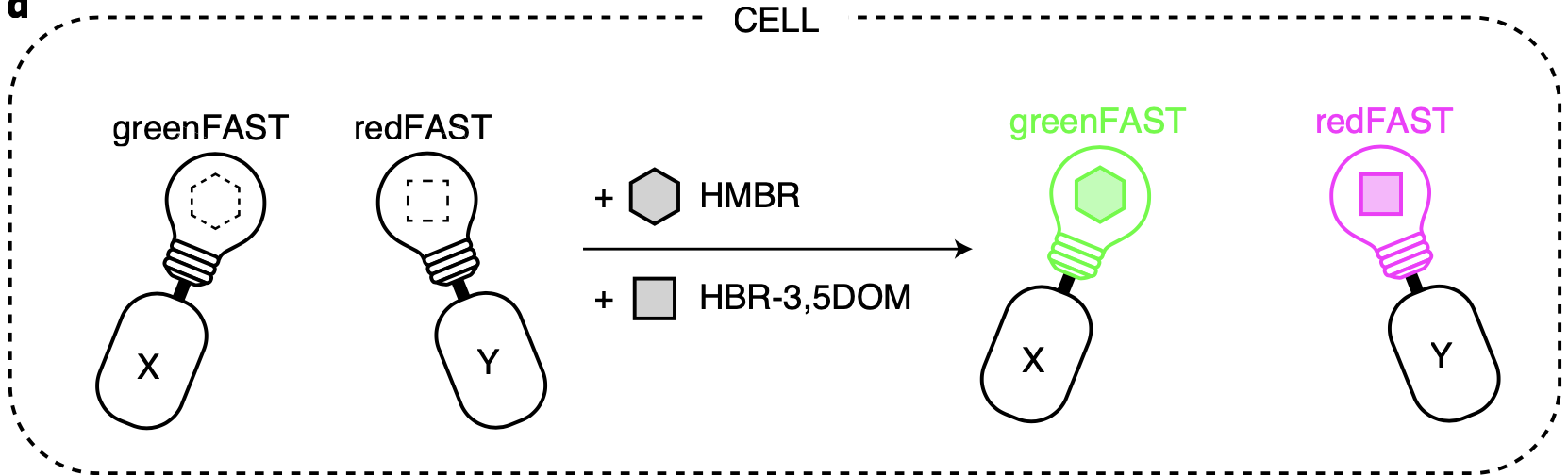
FAST is a small (14 kDa) protein tag that binds a fluorogen, a small molecule that stays dark in solution and lights up only once bound. The fluorogen sets the colour, from TFLime (green, ~541 nm) through TFAmber, TFCoral and TFPoppy to TFCarmine (near-infrared, ~715 nm). To image several targets at once, FAST variants that prefer different fluorogens let each target report in its own colour:
- greenFAST and redFAST are an orthogonal pair. greenFAST lights up with HMBR (TFLime) and redFAST with HBR-3,5DOM (TFCoral), so two proteins tagged in the same cell report in two colours while both fluorogens are added together. The pair was used to build a two-colour cell-cycle sensor that resolves the very short early cell cycles of zebrafish embryos, and split versions detect several protein–protein interactions in the same cell (Tebo et al., Nat. Chem. Biol. 2021).
- frFAST (far-red, with TFPoppy) and nirFAST (near-infrared, with TFCarmine) move the label out of the crowded visible range, leaving green and red free for fluorescent proteins and biosensors. frFAST was imaged in live cells, zebrafish and chicken embryos (Angew. Chem. Int. Ed. 2020); nirFAST supports spectral multiplexing in cultured cells, chicken embryo tissue and zebrafish larvae, and a two-colour cell-cycle indicator (Nat. Commun. 2025).
- Alongside other labels. FAST works next to GFP-like proteins, HaloTag® and SNAP-tag®, which adds further independent channels. In anaerobic Clostridium, for instance, FAST was used side by side with HaloTag and SNAP-tag reporters (Appl. Environ. Microbiol. 2020). See also our comparison of HaloTag, SNAP-tag, GFP and FAST.
2. By fluorescence lifetime: several tags in one colour
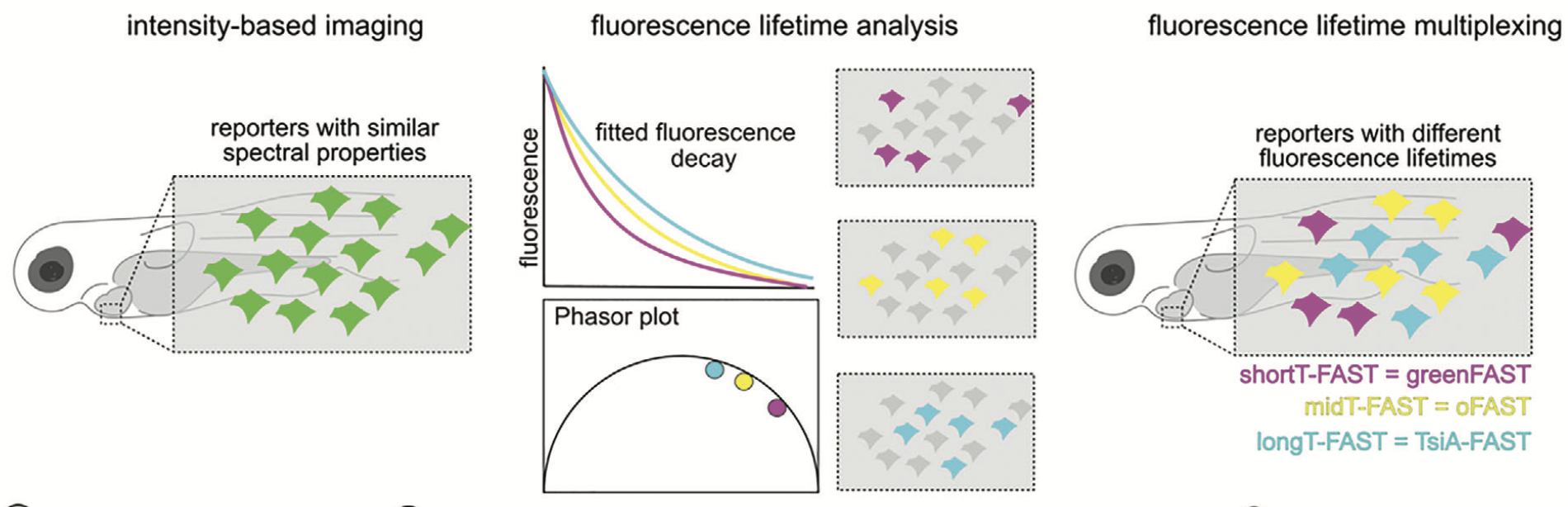
Fluorescence lifetime imaging (FLIM) separates labels by how long they stay excited rather than by their colour. Small changes in the FAST protein sequence change the environment of the bound fluorogen, and with it the fluorescence lifetime. These lifetime-modulating FAST tags image up to three targets in one spectral channel with a single fluorogen, in live cells and live zebrafish larvae; combined with spectral multiplexing, they image six targets in live cells (El Hajji et al., Adv. Sci. 2024). An independent team reached the same conclusion with its own FAST variants, distinguishing two intracellular structures by lifetime alone (Bogdanova et al., Commun. Biol. 2024). A step-by-step protocol is available (Bio-protocol 2025), and a far-red fluorogen extends lifetime multiplexing beyond the visible (Int. J. Mol. Sci. 2026). More in our post on multiplex FLIM with lifetime-modulating FAST tags.
3. By time: labels you can exchange or switch off
Because FAST binds its fluorogen non-covalently, a label is not fixed for the life of the sample. Wash one fluorogen out and add another, and the same tagged protein reports in a new colour. This dynamic colour switching also allows FAST-tagged proteins to be picked out selectively in cells that already contain green and red fluorescent species, by two-colour cross-correlation (Li et al., Chem. Sci. 2017; see One tag, many colours).
With pFAST, a channel can even be reused within one experiment: the dark quencher TFDarth outcompetes the bound fluorogen and switches pFAST fluorescence off within seconds, without washing, and an excess of fluorogen switches it back on (Benaissa et al., Nat. Commun. 2021; see also reversible labelling).
4. By light: photoswitching and photoconversion
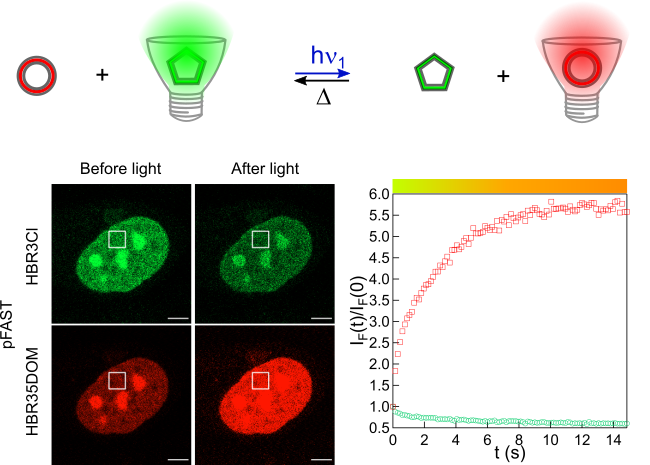
By adjusting fluorogen concentration and illumination, FAST labels behave as reversible photoswitchers, and pairs of fluorogens give reversibly photoconvertible tags that change colour under light and change back. Reading how each label responds to illumination over time in several channels discriminates six spectrally similar FAST variants in live cells (Adv. Sci. 2026; see our post on photoconvertible FAST tags). RSpFAST, a reversibly photoswitchable pFAST, uses the same principle to separate a FAST label from a fluorescent protein in the same spectral channel: in live HeLa cells, EGFP at the membrane and RSpFAST in the nucleus were recorded together, then split into two pure images by their different response to light (J. Am. Chem. Soc. 2026).
Combining the dimensions
Colour, lifetime and switching are independent, so they multiply rather than add. Lifetime combined with colour already gave six targets in live cells, and switching adds a time dimension on top. In practice you can keep your existing fluorescent proteins and biosensors, and place FAST labels in the channels and lifetimes they leave free.
Why FAST for live-cell multiplexing
- Small and monomeric: 14 kDa, minimal impact on the protein you tag.
- Fast and oxygen-independent: no chromophore maturation, so the signal appears within seconds, including in anaerobic and hypoxic samples.
- No wash needed: fluorogens are dark until bound, so background stays low.
- One construct, many readouts: colour and switching are set by the fluorogen you add, not by re-cloning.
What it is not designed for
FAST multiplexing is built for living samples followed over time, typically with up to about six targets. For fixed tissue sections stained with dozens of antibodies (cyclic immunofluorescence, imaging mass cytometry), dedicated spatial-proteomics platforms remain the right tool.
Frequently asked
How many targets can I image at once with FAST?
Two by colour with the orthogonal greenFAST and redFAST pair, more when you add far-red or near-infrared FAST and your fluorescent proteins; up to three per spectral channel by fluorescence lifetime; and six have been shown by combining lifetime and colour in live cells.
Do I need a FLIM microscope?
Only for lifetime multiplexing. Colour multiplexing, fluorogen exchange and TFDarth switching work on standard widefield and confocal microscopes.
Can FAST be combined with GFP, mCherry, HaloTag or SNAP-tag?
Yes. FAST uses its own fluorogens and does not react with the ligands of self-labelling tags, so it adds independent channels next to them. It can even share a channel with EGFP: RSpFAST is told apart from EGFP by its response to light.
Which fluorogens should I order?
For two colours with greenFAST and redFAST: TFLime and TFCoral. To keep green and red free: TFPoppy (far-red) or TFCarmine (near-infrared). To switch pFAST off: TFDarth. All fluorogens are on the products page, and we are happy to advise: request a quote.
Recent papers: FAST for multiplexed imaging
Non-Covalent Reversibly Photoconvertible Fluorescent Tags for Wash-Free Protein Labeling
Showed that FAST-family tags turn into negative reversible photoswitchers when fluorogen concentration is lowered and light intensity raised, and that pairing two fluorogens yields positive photoswitchers and non-covalent reversibly photoconvertible tags that change color under light. Exploiting this light-driven color change in two spectral channels, the authors distinguish up to six spectrally similar FAST variants in live cells.
Kinetic and Mechanistic Characterization of RSpFAST, a Non-Covalent Versatile Chemogenetic Platform for Fluorescence Imaging
Introduces RSpFAST (a pFAST tag paired with a reversibly photoisomerizable fluorogen) and characterizes its thermokinetics, photochemistry and structure. Reveals a dual regime: a stable wash-free label becomes a negative photoswitcher at low fluorogen concentration and high light (photoejection-driven), enabling dynamic-contrast and super-resolution imaging in live and fixed cells.
Chemogenetic Modulation of Luciferase Emission Color for Imaging and Sensing
Introduced LumiFAST, a chemogenetic way to tune luciferase emission color, for bioluminescence imaging and sensing.
Reversible Chemogenetic Fluorescence Labeling with pFAST in C. elegans
Made a tandem pFAST (td-pFAST) C. elegans strain for reversible multicolor chemogenetic labeling in worms.
Bathochromic Shift via C=O to C=S Substitution: A Far-Red Fluorogen for Multiplexed FLIM with FAST Fluorogen-Activating Protein
Extended the FAST palette into the far-red with HBTR-3,5-DOM, a fluorogen made by C=O-to-C=S substitution.
Fluorescence Lifetime-Based Separation of FAST-Labeled Cellular Compartment
A step-by-step protocol for FAST-based fluorescence-lifetime imaging (FLIM) to separate labels sharing a color channel.
A tunable and versatile chemogenetic near-infrared fluorescent reporter
Introduced nirFAST, a bright 14-kDa near-infrared reporter for deep, multiplexed imaging that also doubles as a CATCHFIRE proximity tool.
Fluorescence lifetime multiplexing with fluorogen activating protein FAST variants
Baranov-group FAST FLIM multiplexing: FAST mutants sharing a fluorogen but differing in fluorescence lifetime, telling several labels apart by lifetime.
Multiplexed In Vivo Imaging with Fluorescence Lifetime-Modulating Tags
Introduced FAST variants tuned to distinct fluorescence lifetimes, enabling highly multiplexed in-vivo imaging by lifetime rather than color.
Establishment of Green- and Red-Fluorescent Reporter Proteins Based on the Fluorescence-Activating and Absorption-Shifting Tag for Use in Acetogenic and Solventogenic Anaerobes
Established greenFAST and redFAST reporters for use in acetogenic and solventogenic anaerobes.
Developing Bright Green Fluorescent Protein (GFP)-like Fluorogens for Live-Cell Imaging with Nonpolar Protein−Chromophore Interactions
Developed brighter GFP-like fluorogens for FAST using nonpolar protein-chromophore interactions.
Orthogonal fluorescent chemogenetic reporters for multicolor imaging
Introduced greenFAST and redFAST, spectrally orthogonal FAST variants, for simultaneous two-color imaging in live cells and zebrafish.
Development of Strong Anaerobic Fluorescent Reporters for Clostridium acetobutylicum and Clostridium ljungdahlii Using HaloTag and SNAP-tag Proteins
Developed strong anaerobic FAST reporters for Clostridium acetobutylicum and C. ljungdahlii.
A Far-Red Emitting Fluorescent Chemogenetic Reporter for In Vivo Molecular Imaging
Introduced frFAST, a far-red FAST variant, for spectral multiplexing and deep-tissue in-vivo imaging in zebrafish and mammalian cells.
Single-Molecule Localization Microscopy with the Fluorescence-Activating and Absorption-Shifting Tag (FAST) System
Demonstrated FAST for single-molecule localization super-resolution microscopy, exploiting its fast fluorogen on/off binding to pinpoint molecules.
Live cell super resolution imaging by radial fluctuations using fluorogen binding tags
Applied FAST to super-resolution radial-fluctuation (SRRF) imaging, exploiting its stochastic fluorogen binding.
High-throughput, image-based screening of pooled genetic-variant libraries
A high-throughput image-based screening method for pooled genetic-variant libraries, with FAST-relevant readout.
Fluorogenic Labeling Strategies for Biological Imaging
A review of fluorogenic labeling strategies for lighting up proteins and RNA in live cells, situating FAST among the emerging chemogenetic tools.
Dynamic multicolor protein labeling in living cells
Showed FAST can be imaged in several colors by swapping fluorogens, enabling dynamic multicolor labeling of proteins in living cells.
Small fluorescence-activating and absorption-shifting tag for tunable protein imaging in vivo
The founding FAST paper: a 14-kDa tag, half the size of GFP, that fluoresces only while reversibly bound to its fluorogen, giving wash-free, tunable, reversible protein labeling.
No publications match your filters.
Other Applications

Anaerobic imaging

Detecting protein-protein interactions
Protein & cell labeling
One tag, many colors

Reversible labeling, Silent Tag

A toolkit for sensing