A new fluorogen turns the pFAST tag into a reversible photoswitch, and that opens up imaging you cannot do with an ordinary green label.
RSpFAST is not a new tag. It is the pFAST tag paired with a fluorogen that light can flip between two forms. Bound inside pFAST, the fluorogen’s Z form glows. Illuminate it and the bound fluorogen switches to the E form which is ejected from the tag’s pocket, switching off the signal. In the dark it relaxes back, rebinds, and the fluorescence returns on its own within seconds. Keep the fluorogen plentiful and the light gentle and you have an ordinary wash-free label; drop the fluorogen below about a micromolar and raise the light, and the same reagent becomes a reversible switch that can be driven almost fully dark. It was reported in J. Am. Chem. Soc. 2026 by Shpinov, Mandal and co-workers from the group of Ludovic Jullien at ENS-PSL, with partners in Grenoble and at KU Leuven.
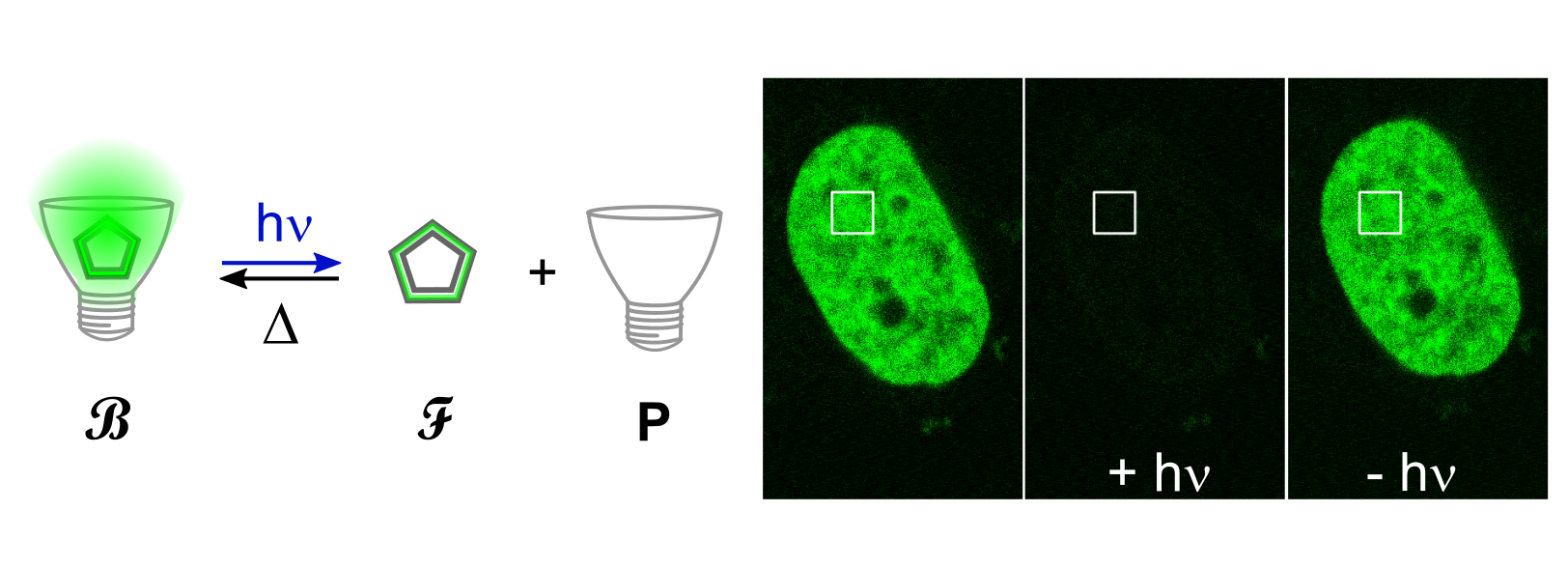
The RSpFAST photocycle and its readout in cells. The bright bound state (B) loses its fluorogen (F) from the protein (P) under light and recovers in the dark; in a labelled nucleus the signal switches off under illumination (+ hν) and returns in the dark (- hν). Reprinted with permission from the Authors. © 2026 American Chemical Society.
That switch is not a novelty for its own sake. It is what lets you separate signals that share a colour.
Clean up the green channel. RSpFAST blinks on command; autofluorescence does not. Correlate each pixel with the switching rhythm and everything that stays put, chlorophyll in plant cells, tissue background, the haze from fixatives, is rejected, leaving the specific signal. This matters because the green-yellow band where FAST emits is exactly where autofluorescence is worst.
Add a target without spending a colour. Two green labels that would normally be impossible to tell apart can be separated by their kinetics instead of their spectra. You can run RSpFAST alongside a GFP-based biosensor, a calcium indicator such as GCaMP, or a redox or voltage sensor, and let the sensor keep its channel while RSpFAST reports a second target in the same green window.
Super-resolution, gently. The same on and off blinking feeds super-resolution optical fluctuation imaging (SOFI), so you get resolution past the diffraction limit with visible light alone, no activation laser and no special buffer, on a 14 kDa tag about half the size of a fluorescent protein. The authors show it on the actin cytoskeleton in living cells.
The method works whenever the interfering signal overlaps in colour but differs in switching, which is precisely the green-channel case above.
For years Ludovic Jullien has argued that the kinetics of a light-driven reaction are a resource, not noise: modulate the light, read the response, and use timing as its own channel of contrast. RSpFAST carries that idea into a chemogenetic tag, and the mechanism is pinned down carefully, with fluorescence spectroscopy, light-coupled NMR and kinetic modelling all agreeing.
Read the paper: https://doi.org/10.1021/jacs.6c08277
Recent Comments