FLIM-FRET is the most quantitative way to see two proteins come together in a living cell. Its weak spot is the reference: what does “no FRET” look like in that same cell? A new study answers with a FAST acceptor you switch on and off with a fluorogen.
The work comes from the group of Deepak Nair (Centre for Neuroscience, Indian Institute of Science, Bangalore), by Nivedita Singh and colleagues, published in Advanced Science in September 2026.
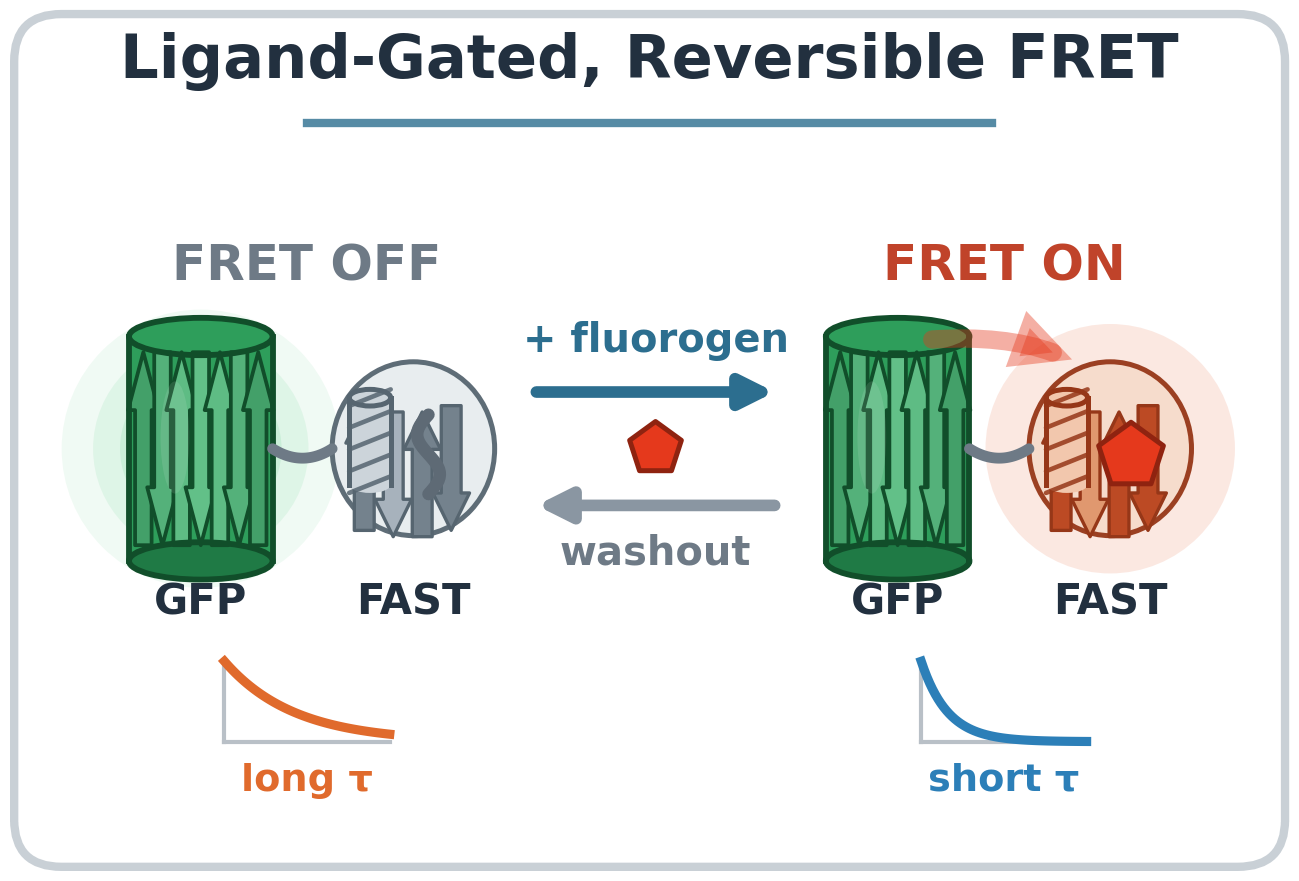
Adding the fluorogen switches the FAST acceptor on and shortens the GFP donor lifetime. Washing it out switches FRET off again. Graphical abstract reproduced from Singh, N. et al., Adv. Sci. 2026, under a CC BY 4.0 licence. © 2026 The Author(s). Advanced Science published by Wiley-VCH GmbH.
FRET and FLIM in brief
FRET (Förster resonance energy transfer) is a proximity rule. When an excited donor fluorophore sits within less than a few nm of a suitable acceptor, it hands its energy over instead of emitting light itself. No transfer means the partners are apart. Transfer means they are almost touching. That is why FRET is used to detect protein interactions and conformational changes.
FLIM (fluorescence lifetime imaging) measures not how much light a molecule emits, but how long it stays excited before emitting, a few nanoseconds. Under FRET the donor has an extra way to release its energy, so its lifetime gets shorter. FLIM-FRET reads the interaction from that shortening. Because the lifetime does not depend on concentration or excitation intensity, it is widely regarded as the most robust FRET readout, and it can tell what fraction of the molecules is actually interacting. FAST already has a lifetime track record: lifetime-modulating FAST variants let several labels be told apart by lifetime alone.
How the main FRET readouts compare
| Method | What it measures | Strength | Limit |
|---|---|---|---|
| Intensity-based FRET (ratiometric, sensitized emission) | Acceptor emission relative to donor emission | Simple, fast, standard microscopes | Needs corrections for spectral bleed-through and expression levels to be quantitative |
| Acceptor photobleaching | Donor recovery after the acceptor is destroyed | Direct and easy to interpret | Destructive: one measurement per cell, no live follow-up |
| FLIM-FRET | Shortening of the donor lifetime | Quantitative, independent of concentration and intensity, resolves the interacting fraction | Specialized equipment, slower acquisition, needs a donor-only reference |
The weak spot, and the fix
A lifetime only means something against a reference: the donor lifetime without FRET. That reference usually comes from separate cells expressing the donor alone, which assumes those cells behave like the ones being measured. The new study removes that assumption. The FAST tag is dark on its own and becomes an acceptor only while its fluorogen is bound. Add the fluorogen and FRET switches on. Wash it out and it switches off. Each cell provides its own donor-only baseline.
The numbers make the point. In cells expressing a GFP-FAST fusion, the GFP lifetime was about 2.38 ns without fluorogen, indistinguishable from GFP alone. It fell to 1.59 ns with 10 µM fluorogen and returned to 2.40 ns after washout.
What else the paper shows
- A tuning knob. FRET efficiency rises with fluorogen concentration, a control axis independent of expression level or construct design.
- A structural picture. Crystal structures of empty and fluorogen-bound FAST show N-terminal residues capping the empty pocket and moving aside when the fluorogen binds.
- A live-cell application. Ligand-gated FLIM-FRET mapped the organization of the C-terminal region of the synaptic scaffold proteins PSD95 and SAP97 in living cells.
The authors are candid about the trade-off. A dedicated dark acceptor (sREACh) quenched the donor more strongly than fluorogen-activated FAST. The gain is not raw transfer efficiency but control, tunability and internal calibration.
FAST is showing up as a FRET acceptor in other labs too. A recent preprint used FAST-based FRET pairs, read by cryogenic FLIM and correlated with cryo-electron tomography, to link early HIV-1 maturation to the clustering of the viral envelope protein (bioRxiv, 2025). It is not yet peer reviewed, but QED Science ranked it in The 1%: the top 574 of 57,455 bioRxiv preprints, scored anonymously for originality and validity.
The imaging used FAST fluorogens such as TFCoral (HBR-3,5DOM) and TFAmber (HBR-3,5DM), available from The Twinkle Factory. FAST plasmids are available through Addgene.
More reading on FLIM-FRET and FAST
- Reversible, Chemically Gated FRET via Ligand-Activated Acceptors. Singh, N., Nayak, S. R., Mohanty, S. K., Hanumantharaju, A., Shaju, A., Jose, M., Penmatsa, A., Nair, D. Advanced Science 2026, e77693. doi.org/10.1002/advs.77693
- Multiplexed In Vivo Imaging with Fluorescence Lifetime-Modulating Tags. El Hajji, L., Lam, F., Avtodeeva, M., Benaissa, H., Rampon, C., Volovitch, M., Vriz, S., Gautier, A. Advanced Science 2024, 11(32), 2404354. doi.org/10.1002/advs.202404354 (FLIM)
- Early HIV-1 maturation drives Env clustering and fusion competence. Carlon-Andres, I., Garcia-Giner, V., Williamson, D. J., Ravi, R. T., Le Bas, A., Ward, P. N., Starling, T., El Hajji, L., Gautier, A., Simoncelli, S., Grange, M., Dumoux, M., Padilla-Parra, S. bioRxiv 2025, preprint. doi.org/10.64898/2025.12.11.693442 (FRET and cryo-FLIM)
- Evaluating the far-red emitting fluorescence-activating and absorption-shifting tag (frFAST) chemogenetic labeling system for live-cell super-resolution microscopy. Kozma, E., Novák, T., Szatmári, Á., Török, G., Nikić-Spiegel, I., Cserép, G. B., Németh, K., Czvik, E., Erdélyi, M., Kele, P. Methods Appl. Fluoresc. 2026, 14(4), 045004. doi.org/10.1088/2050-6120/ae9fb8 (FRET)
- Chemogenetic Modulation of Luciferase Emission Color for Imaging and Sensing. Manirakiza, H., Shpinov, Y., Gontier, A., El Hajji, L., Jullien, L., Gautier, A. ACS Sensors 2026, 11(4), 3156-3165. doi.org/10.1021/acssensors.5c04421 (BRET, the same energy-transfer physics with a luciferase as the donor instead of light excitation. See our post on LumiFAST.)
Recent Comments