Turn a protein’s activity on, then off again, with a single small molecule. A new study turns CATCHFIRE into a versatile chemical switch for controlling enzymes and gene expression, reversibly and on demand.
The work comes from the teams of Prof. Arnaud Gautier (Sorbonne Université, ENS-PSL) and Dr. Franck Perez (Institut Curie), two of The Twinkle Factory’s scientific co-founders, by J. Franco Pinto, N. Drahy, S. Divoux, F. Perez and A. Gautier, published in ACS Chemical Biology 2026.
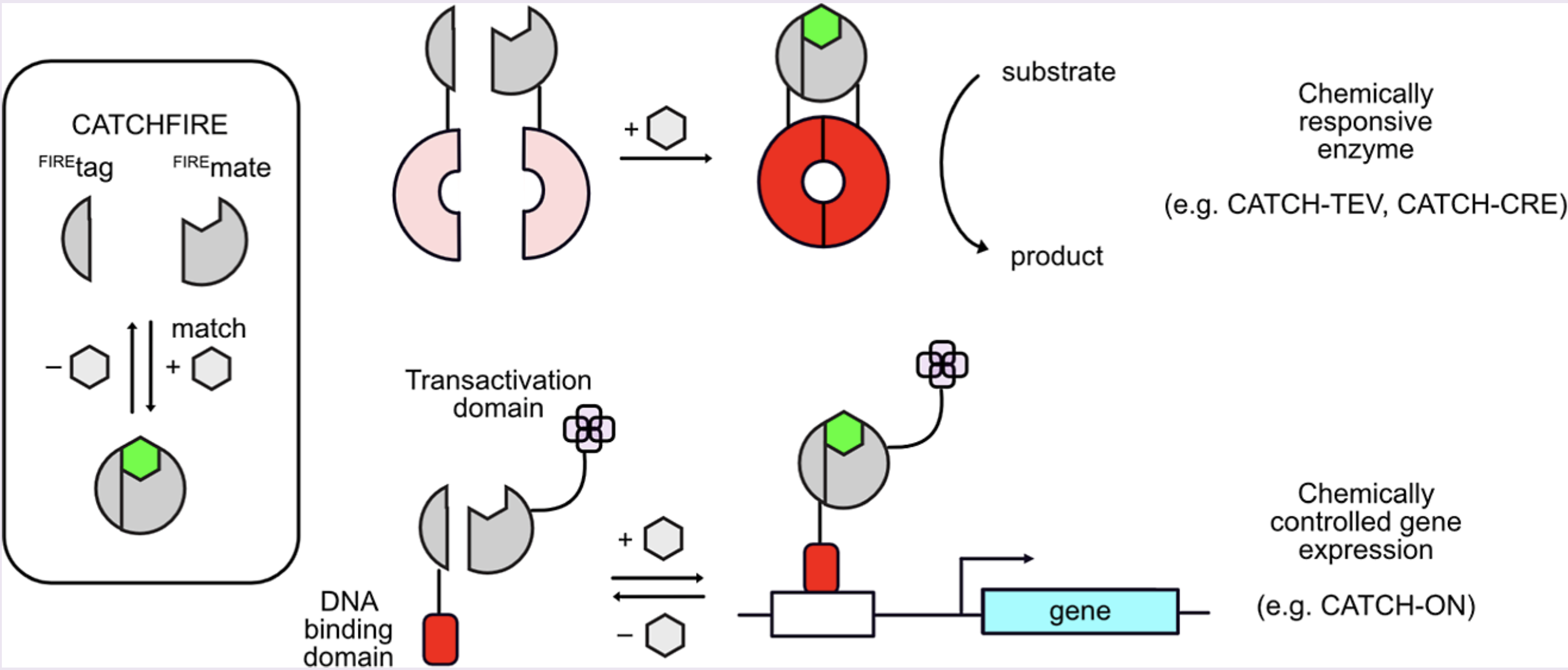
CATCHFIRE assembles FIREtag and FIREmate on demand to switch on a split enzyme (top; CATCH-TEV, CATCH-CRE) or, via CATCH-ON, a gene (bottom). © 2026 The Authors.
CATCHFIRE (chemically assisted tethering of chimera by fluorogenic induced recognition) glues two protein partners together only when its fluorogenic inducer is present, and lets them fall apart again once it is washed out. The switch reports itself. Because the inducer is itself the fluorogen, the same molecule that drives assembly also lights it up, so there is nothing extra to engineer in. Other chemically induced dimerization systems typically need a separate reporter alongside, which makes the construct bulkier and the readout more indirect.
That reversible, on-demand proximity is the perfect basis for a switch, and the authors used it three ways.
What CATCHFIRE switched on
- Split enzymes. Splitting an enzyme in two inactivates it; adding the CATCHFIRE inducer reassembles the halves and restores function. The authors demonstrated this for split luciferases, proteases and DNA recombinases.
- CATCH-ON, an inducible gene-expression system. By fusing the GAL4 DNA-binding domain to a truncated p65 activator (p65Δ), the two come together only when CATCHFIRE brings them into proximity, so a target gene switches on only in the presence of the inducer.
- Therapeutically relevant outputs. Through CATCH-ON the team controlled the expression of proteases, DNA recombinases and suicide switches, and the secretion of insulin.
Why it matters
The CATCH-ON system is fast-acting, reversible and titratable, so the level of activity can be dialled up or down with the dose of inducer. It is non-toxic and compatible with other chemically induced dimerization systems. Together, that opens precise, switchable control of cellular functions for basic research, biotechnology and cell therapy, from controllable insulin release to built-in safety switches.
CATCHFIRE runs on the self-reporting fluorogenic molecular glues that The Twinkle Factory distributes. This study used match550 (HBR-2,5DM) as the inducer; we also supply match540, match600 and the quencher matchDark. The FIREtag and FIREmate plasmids are available through Addgene.
More reading on CATCHFIRE
- Chemically Responsive Protein Switches for the Precise Control of Biological Activities. Franco Pinto, J., Drahy, N., Divoux, S., Perez, F., Gautier, A. ACS Chem. Biol. 2026, 21(8), 1958-1971. doi.org/10.1021/acschembio.6c00360
- The princeps paper: A fluorogenic chemically induced dimerization technology for controlling, imaging and sensing protein proximity. Bottone, S., Joliot, O., Cakil, Z.V., El Hajji, L., Rakotoarison, L.-M., Boncompain, G., Perez, F., Gautier, A. Nat. Methods 2023. doi.org/10.1038/s41592-023-01988-8
Recent Comments