Light can now change the colour of a FAST label, and change it back. A new study shows that FAST tags researchers already use, combined with the right fluorogens, become reversible photoswitches across the whole visible range, and even reversibly photoconvertible tags, with no covalent chemistry and no washing.
The work comes from the group of Ludovic Jullien (ENS-PSL), with Arnaud Gautier (Sorbonne Université) and Franck Perez (Institut Curie), by Mrinal Mandal, Yuriy Shpinov and colleagues, published in Advanced Science in September 2026. It follows RSpFAST, the light-switchable pFAST reported this summer.
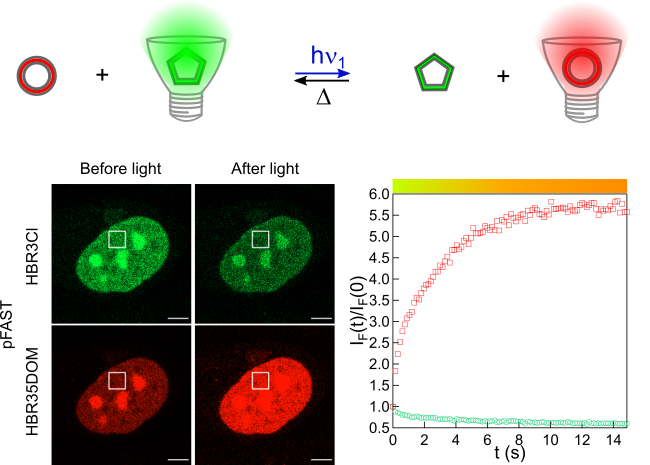
Under light, the green fluorogen leaves the tag and a red one takes its place. In the dark, the green one comes back. Graphical abstract reproduced from Mandal, M. et al., Adv. Sci. 2026, under a CC BY 4.0 licence. © 2026 The Author(s). Advanced Science published by Wiley-VCH GmbH.
Three behaviours from the same tag
- Switch off with light, across the palette. Lower the fluorogen to the submicromolar range and use ordinary microscope illumination: the light-flipped fluorogen is ejected from the tag and the signal drops, then returns in the dark. The authors show it for many FAST variants and fluorogens, across the whole visible range.
- Switch on with light. Pair a fluorogen that gives a dark complex with one that gives a bright complex, and illumination makes the label brighter instead of dimmer.
- Change colour with light. Pair a green and a red fluorogen. Under light, the green one is ejected and the red one takes its place, so the label turns from green to red. In the dark, it turns back. Regular fluorescent proteins offer no such reversible colour change.
Telling six look-alike tags apart
Each FAST variant responds to light at its own pace. Reading that response in two colour channels gives every variant a distinct fingerprint. With a single pair of fluorogens, the team told apart six spectrally similar FAST variants in live cells, with 98% accuracy. One channel alone separates only three or four.
Beyond intensity
Most fluorescent labels give one signal: how bright they are. FAST offers more, because its fluorogen binds reversibly. What the fluorogen does under light, over time or next to another fluorophore becomes a readout of its own:
- Colour and kinetics. Photoswitching and photoconversion, as here and with RSpFAST, separate labels that share a colour.
- Lifetime. Lifetime-tuned FAST variants are told apart by FLIM. Used as a fluorogen-activated FRET acceptor, pFAST lets FRET be measured in a single experiment, by recording the donor’s lifetime before and after adding the fluorogen (Benaissa et al., 2021).
- Chemistry. The function is set by the fluorogen in the medium, not by re-engineering the protein. The same tag can be a stable label, a photoswitch or a photoconvertible marker.
Each new fluorogen and each new illumination protocol can open another readout, and many of these set-ups remain to be explored. This study is the latest step in a long-standing collaboration between the groups of Ludovic Jullien, Arnaud Gautier and Franck Perez.
FAST plasmids are available through Addgene.
More reading on light-controlled FAST
- Non-Covalent Reversibly Photoconvertible Fluorescent Tags for Wash-Free Protein Labeling. Mandal, M., Shpinov, Y., Lahlou, A., Pham, F., El Hajji, L., Coghill, I., Laureau, E., Plamont, M.-A., Perez, F., Le Saux, T., Aujard, I., Gautier, A., Jullien, L. Advanced Science 2026, e78041. doi.org/10.1002/advs.78041
- Kinetic and Mechanistic Characterization of RSpFAST, a Non-Covalent Versatile Chemogenetic Platform for Fluorescence Imaging. Shpinov, Y., Mandal, M., van Deuren, V., Lahlou, A., Le Bec, M., Chouket, R., Hadj Moussa, C., Bonin, C., Sepasi Tehrani, H., Coghill, I., El Hajji, L., Ounoughi, K., Franco Pinto, J., Plamont, M.-A., Pelupessy, P., Ayala, I., Perez, F., Aujard, I., Le Saux, T., Gautier, A., Dedecker, P., Brutscher, B., Jullien, L. J. Am. Chem. Soc. 2026, 148(35), 37874-37883. doi.org/10.1021/jacs.6c08277 (see our post on RSpFAST)
Recent Comments