CATCHFIRE decides which sister cell becomes a neuron. In a new Nature Communications 2025 paper, our fluorogenic molecular-glue technology is used not to image but to act: it physically displaces mitochondria during cell division to control the fate of the daughter cells.
The study is led by the teams of Xavier Morin and Prof. Arnaud Gautier, by Benjamin Bunel, Rosette Goïame, Évelyne Fischer and colleagues. It is the published, peer-reviewed sequel to the preprint we first flagged in December 2024, and it earned coverage in Le Monde.
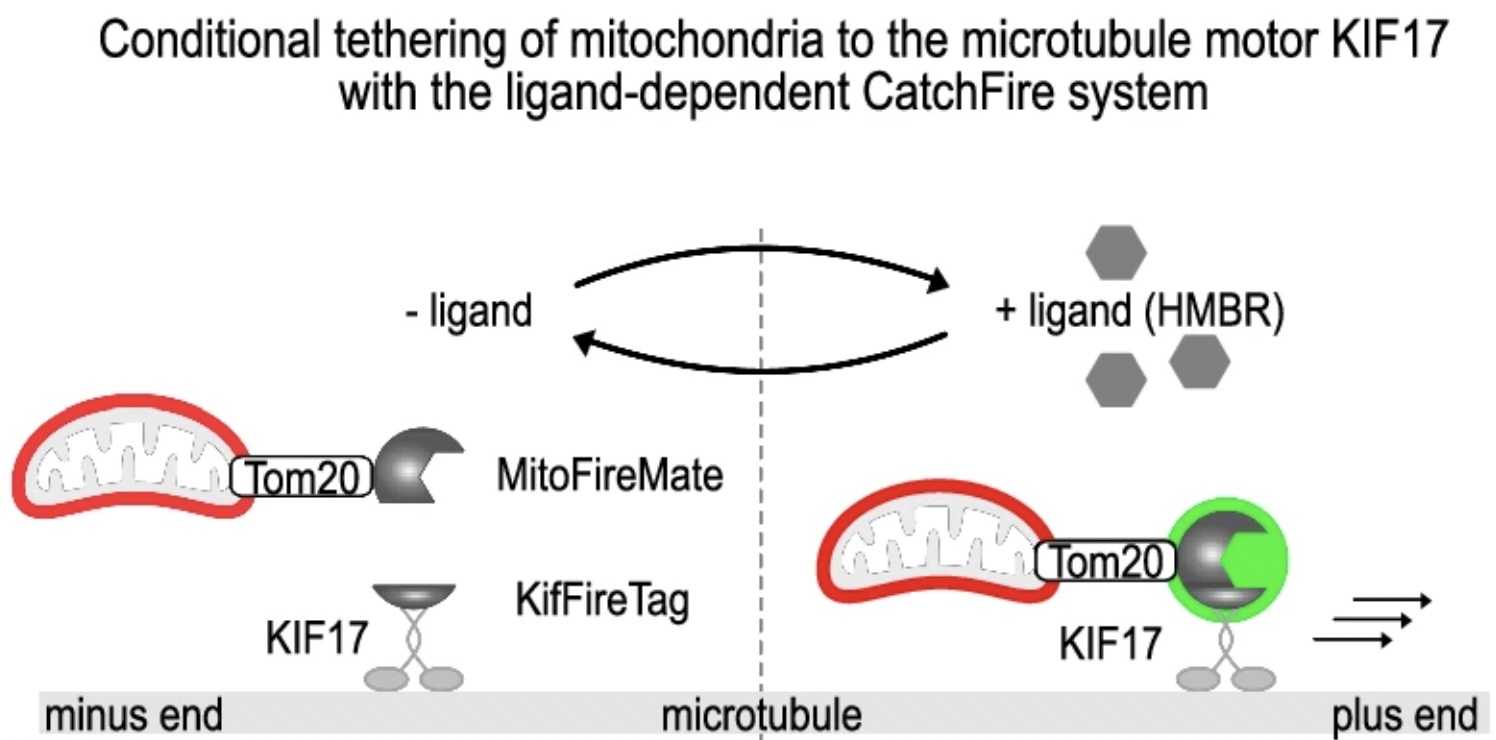
CATCHFIRE tethers mitochondria to the KIF17 motor on demand, hauling them along microtubules. © The authors.
The biology: during vertebrate neurogenesis, a progenitor divides asymmetrically to make one neuron while keeping one progenitor. Using live imaging in the chick embryonic neuroepithelium, the authors show that mitochondria themselves behave as asymmetric fate determinants. The frequency of unequal mitochondrial distribution rises in step with the rate of asymmetric divisions during development, and, strikingly, the daughter that inherits fewer mitochondria is the one that consistently becomes a neuron.
To prove this is causal, not just correlated, the authors needed to force mitochondria to one side of a dividing cell, on demand, only during mitosis. That is exactly what CATCHFIRE enables:
- MitoFireMate anchors the FIREmate partner to the mitochondrial surface (via Tom20).
- KifFireTag puts the FIREtag on the kinesin motor KIF17.
- Adding the fluorogenic inducer (match) glues the two together, so the motor drags mitochondria along microtubules toward one spindle pole, reversibly and only when the inducer is present.
Forcing this unequal inheritance drove premature neuronal differentiation, establishing a direct causal link between mitochondrial inheritance and sister-cell fate in vivo.
This is the second disclosure of CATCHFIRE as an inducible protein-proximity tool in mammalian systems, after the 2023 princeps paper, and the first time it is used to reposition an organelle to steer a developmental decision. The Twinkle Factory distributes the self-reporting fluorogenic molecular glues match540, match550 and match600 together with the quencher matchDark; the FIREtag and FIREmate plasmids are available through Addgene.
More reading on CATCHFIRE
- Unequal mitochondrial segregation promotes asymmetric fates during neurogenesis. Bunel, B., Goïame, R., Morin, X., Gautier, A., Fischer, É. Nat. Commun. 2025, 16. doi.org/10.1038/s41467-025-66932-0
- The princeps paper: A fluorogenic chemically induced dimerization technology for controlling, imaging and sensing protein proximity. Bottone, S., Joliot, O., Cakil, Z.V., El Hajji, L., Rakotoarison, L.-M., Boncompain, G., Perez, F., Gautier, A. Nat. Methods 2023. doi.org/10.1038/s41592-023-01988-8
Recent Comments