FAST in plants for the first time. Already a workhorse in mammalian cells, yeast and anaerobes, the fluorescence-activating and absorption-shifting tag (FAST) is now disclosed as a versatile protein marker for live plant cell imaging.
A collaborative French effort (Pascale David, Morgane Michaud, Laurent Nussaume, Norbert Rolland, Édouard Bertrand, Prof. Arnaud Gautier and colleagues, from CEA, CNRS and Sorbonne Université) published it in The Plant Journal 2026.
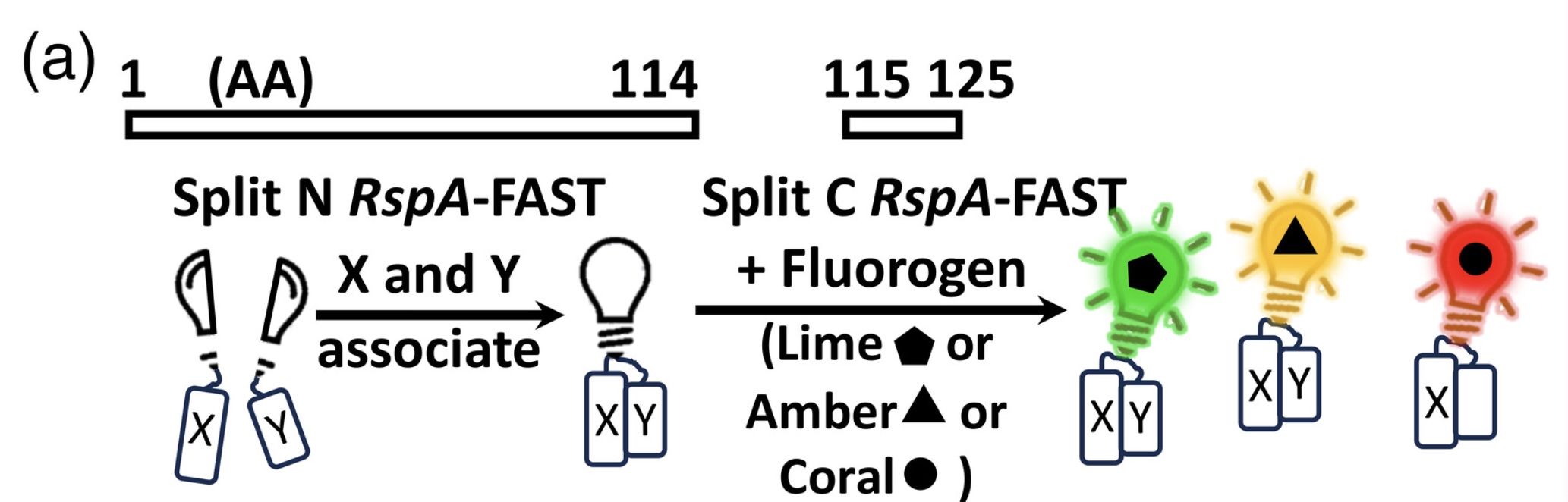
Split RspA-FAST lights up only when two proteins interact, its colour set by the fluorogen. From David et al. (2026).
The authors ported three FAST variants into plants and put them to work in two standard systems: stable transgenic Arabidopsis thaliana and transient expression in Nicotiana benthamiana.
How the dye gets in: no injection or extra step is needed. In Arabidopsis, the fluorogen is simply supplied to the roots (seedlings bathed in a 10 to 15 µM solution): roots fluoresce within seconds, and aerial tissues such as hypocotyl and leaves after roughly 30 to 40 minutes. In Nicotiana, it is infiltrated into the leaf.
What FAST delivered in planta:
- Clean labelling across compartments. greenFAST (with the TFLime / HMBR fluorogen) and redFAST (with TFCoral / HBR-3,5DOM) marked proteins at the plasma membrane, mitochondria, peroxisomes, nuclei and chloroplasts.
- Protein-protein interactions. A split variant (fragments of 114 and 11 amino acids, read out with the TFAmber / HBR-3,5DM fluorogen) reported the interaction between CAM5 and ceQORH in the cytosol, with reversible complementation.
- Smaller than GFP. At about 14 kDa, FAST is roughly half the size of GFP (about 27 kDa), reducing the risk of steric interference with the tagged protein.
- More photostable. redFAST resisted photobleaching about 3× better than mCherry, and greenFAST outperformed eGFP.
- pH-robust. Both kept binding their fluorogens and fluorescing at pH 5.8, where GFP fluorescence typically fades, a real advantage in the acidic environments of plant cells.
- Switchable. Because the fluorogen binds reversibly, fluorescence can be added or washed away on demand.
For plant biologists, this opens a whole application field with reagents that are already on the shelf. The three fluorogens used in the study (TFLime, TFCoral and TFAmber) are the commercial fluorogens The Twinkle Factory ships at room temperature from the EU; the paper itself points its readers to our catalogue as the source of FAST fluorogens. greenFAST/redFAST and split-FAST plasmids are available through Addgene.
More reading on FAST in plants
- The fluorescence-activating and absorption-shifting tag (FAST), a versatile protein marker for live plant cell imaging. David, P., Michaud, M., Moyet, L., Pullara, S., Lacombe, B., Zhu, J., Gautier, A., Desnos, T., Bertrand, E., Rolland, N., Nussaume, L. The Plant Journal 2026, 126(5). doi.org/10.1111/tpj.70966
Recent Comments